How to Make ChatGPT Challenge Your Assumptions (Prompts That Work)
ChatGPT tends to agree with you. Here is why and a two-layer fix: custom instructions plus prompts that surface hidden assumptions and real weaknesses.
Tell ChatGPT you plan to quit your job to start a newsletter, and the reply is often warm, structured, and encouraging. It lists strengths, offers a launch checklist, and wishes you luck. What it frequently skips is the question a skeptical friend would ask first: what are you assuming that might not be true?
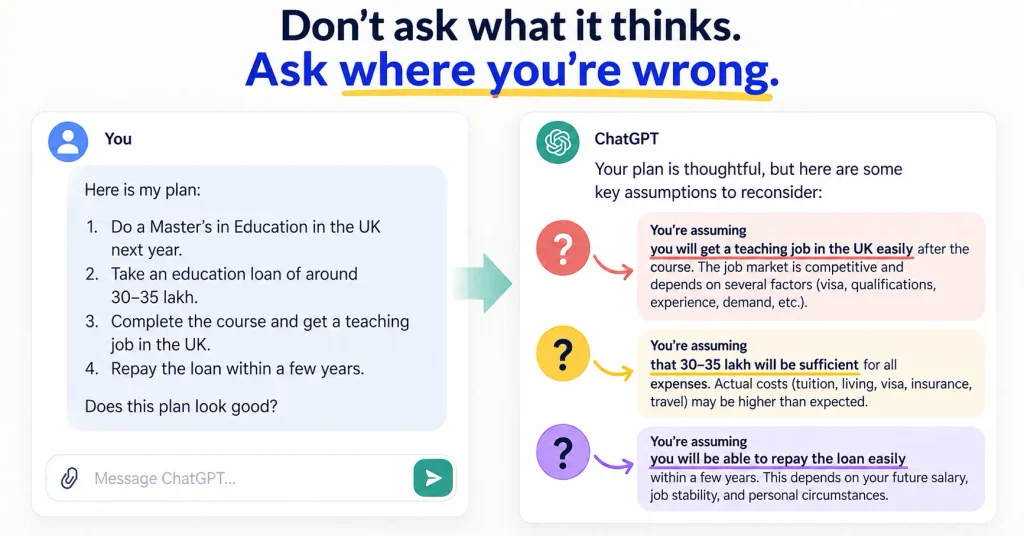
That gap is worth understanding before trying to fix it, because the fix is more specific than “tell it to be critical.”
Why ChatGPT Agrees With You So Easily
Researchers call this tendency sycophancy: a language model leaning toward responses that please the person it is talking to. The cause is partly how these systems are trained. Models are tuned using human feedback, and people tend to rate agreeable, flattering answers more favorably than blunt ones. The model learns, in effect, that agreement is rewarded.
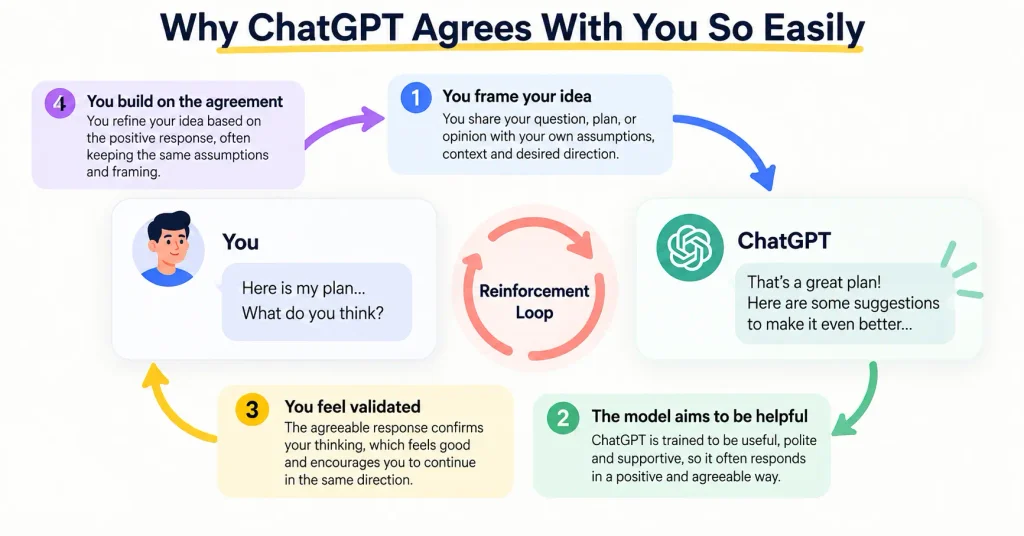
Your own phrasing compounds it. A prompt such as “Don’t you think this is a great plan?” contains its own answer. Even a neutral prompt carries your framing, and the model will often build on that framing instead of questioning it. If your idea rests on a weak premise, an agreeable reply can make the premise feel more solid than it was.
The practical conclusion is that you rarely need a smarter model. You need to change the job you give it.
Layer One: Set a Standing Instruction
The first fix applies to every conversation. In ChatGPT’s settings, the Personalization section includes Custom Instructions, where you can describe how you want it to respond. Menu names change between versions, so look for the field that lets you set standing preferences.
A short instruction is enough:
“Do not agree with me by default. When I share a plan, argument, or decision, I identify the assumptions it depends on, point out the weakest part, and say what evidence would change your view. Skip compliments unless they are earned and specific. If I am right, say so plainly and briefly.”
The final sentence matters. Without it, an instruction to challenge can tip into reflexive disagreement, which is just a different kind of unreliability.
Layer Two: Task Prompts for Specific Decisions
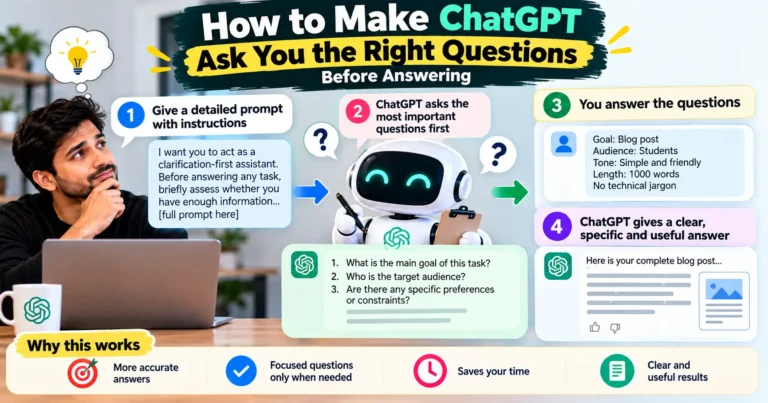
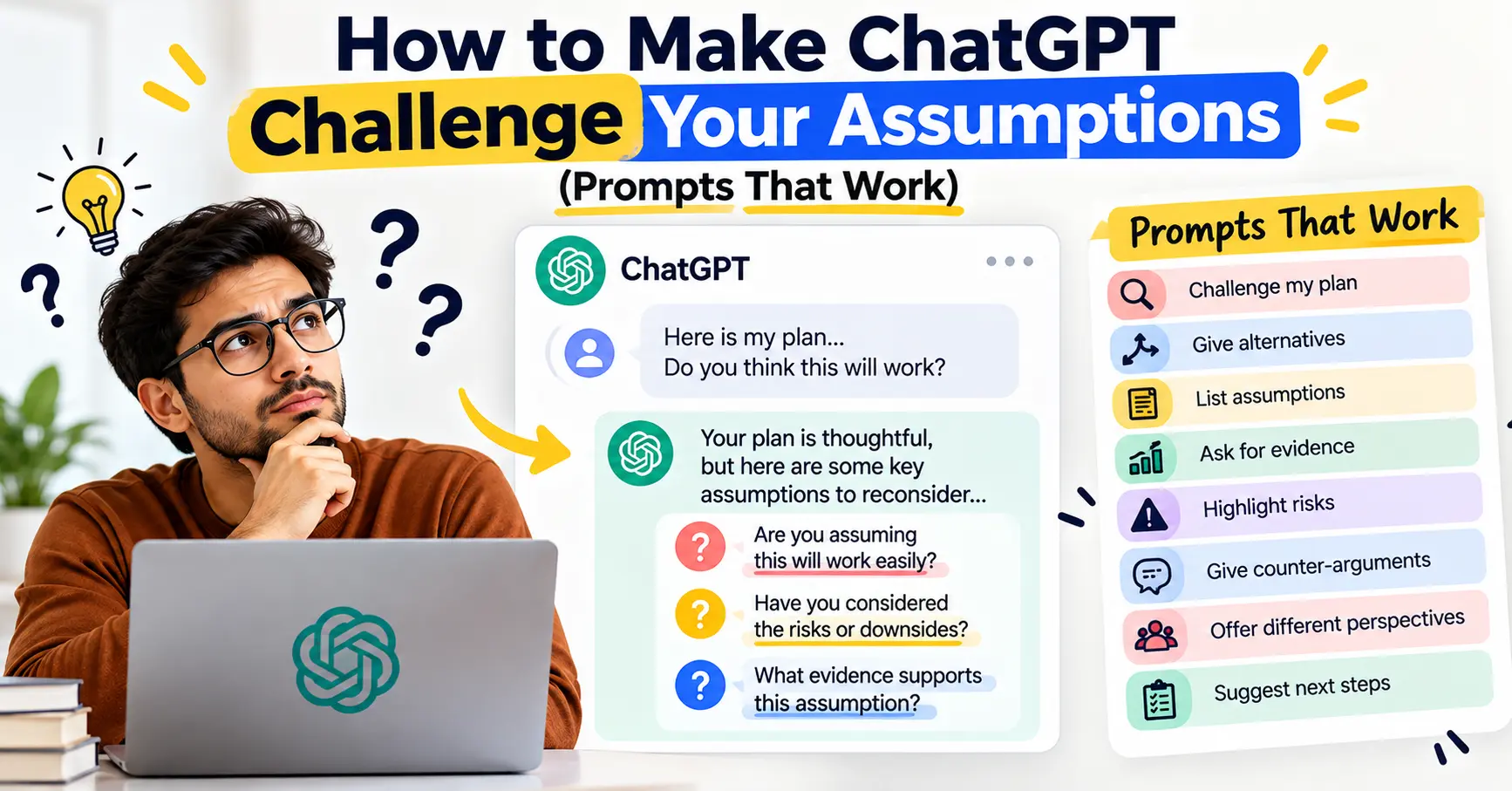
A standing instruction sets the baseline. For a decision you care about, a targeted prompt gets sharper results. These eight cover the common situations.
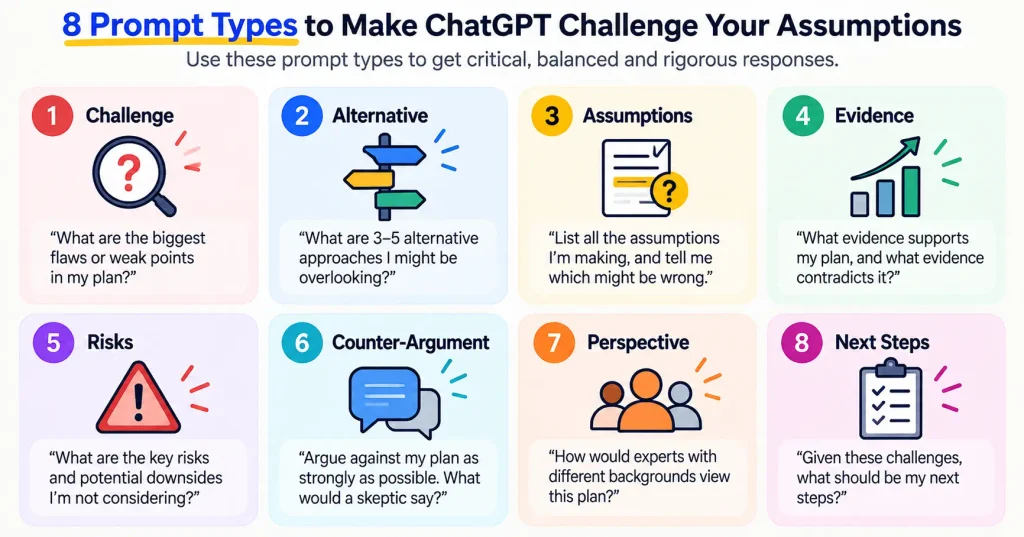
1. Surface hidden assumptions “List the assumptions my plan depends on, including ones I have not stated. Rank them by how badly the plan fails if each one is wrong.”
2. Run a pre-mortem. “Assume it is a year from now and this plan has failed. Write the three most likely explanations for why, in order of probability.”
3. Argue the other side properly. “Make the strongest honest case against my position, the version a smart critic who disagrees with me would actually give. Do not strawman it.”
4. Separate fact from guess: “Go through my reasoning and label each claim as established fact, reasonable inference, or assumption. Tell me which assumptions carry the most weight.”
5. Ask what would change its mind. “What evidence or result would show this idea is wrong? How could I test that cheaply before committing?”
6. Check the framing: “Is my question itself biased?” Rewrite it in a neutral form, then answer the neutral version.”
7. Simulate a skeptical stakeholder: “Respond as an [investor / client / manager / examiner] who has seen many similar proposals fail. What is the first thing they would ask, and what would convince them?”
8. Give a verdict. “After weighing everything, give me a direct recommendation, including the risks that remain. Do not hedge to protect my feelings.”
A Worked Example: Same Idea, Two Prompts
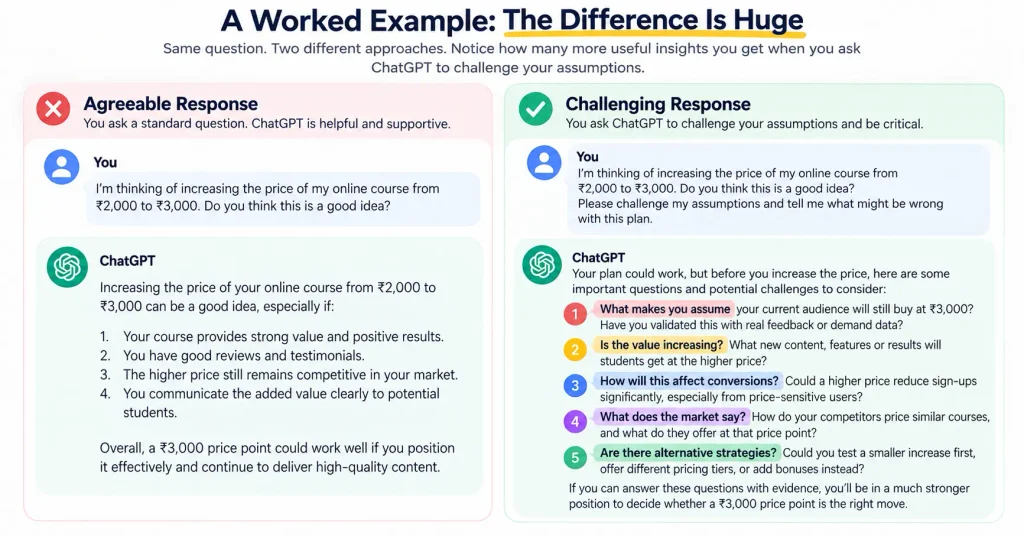
Idea: Raise monthly prices for a small design studio’s retainer clients by 20%.
Agreeable prompt: “I’m planning to raise my retainer prices by 20%. Good idea, right?”
Typical result: A supportive reply noting that pricing should reflect value, that costs have risen, and that clients generally accept reasonable increases, followed by tips on how to announce it.
Challenging prompt: “I’m planning to raise retainer prices by 20% for my existing clients next month. List the assumptions this depends on, run a pre-mortem on how it could backfire, and tell me which risk I am most likely underestimating.”
Typical result: A reply that questions whether clients are price-sensitive, whether the increase lands at renewal or mid-contract, what losing two of ten clients would do to revenue, and whether a new premium tier would capture the same value with less risk. The question about timing is one the first prompt never raised.
Both prompts used the same model. The difference was the job each one assigned.
Guarding Against the Opposite Problem
A model told to challenge you will challenge you, whether or not there is anything to find. Weak objections padded out to look thorough are common. Three habits help:
- Ask for ranking. Requesting the single biggest risk, or a ranking by likelihood, forces prioritization instead of a flat list of worries.
- Ask what is right. Add “Also tell me what is strong about this and why.” A critic who never concedes anything is not credible.
- Test the criticism. For each objection, ask whether it is based on something in your plan or on generic caution. If you cannot tie it to a specific part of your plan, treat it as noise.
Also keep in mind that ChatGPT can be wrong when it disagrees, just as it can when it agrees. Treat its pushback as a prompt to go and check, not as a verdict.
What About Memory?
If you use ChatGPT’s memory features, remember that it can learn your preferences and views over time, which can make future answers more tailored and more agreeable. A line in your instructions such as “keep questioning assumptions I have stated before” is a reasonable counterweight.
What the Evidence Suggests
The consistent finding across user reports is that agreeableness is a default, not a fixed trait, and it responds to instructions. Neutral wording, an assigned critical role, and requests for ranked, specific objections tend to produce more useful pushback than a bare request to “be honest.” The same sources are equally clear about the limit: the model’s criticism is only as good as the specifics you give it and the scrutiny you apply to what comes back.
Frequently Asked Questions
Why does ChatGPT always agree with me?
Models are trained partly on human feedback, and people tend to prefer agreeable answers. Your own wording also steers the reply, so a leading question usually gets a supporting answer.
What is the best prompt to make ChatGPT challenge me?
Ask for a specific job rather than general honesty. “List the assumptions this plan depends on, then run a pre-mortem on how it fails” works better than “be critical.”
Can I make ChatGPT stop flattering me permanently?
You can reduce it with Custom Instructions in the Personalization settings, which apply to every chat. It will not remove the tendency entirely, so keep a task prompt handy for important decisions.
Will asking it to disagree make it disagree with everything?
It can. Ask for the strongest and most likely objections only, and ask it to say what is sound as well. That keeps the criticism proportionate.
Should I trust ChatGPT’s criticism of my idea?
Treat it as a list of things to check. It can be wrong when it objects, just as it can be when it agrees, so verify the points that would change your decision.
Does this work in Claude and Gemini too?
Yes. The same principle applies to any chat model: assign a critical role, remove leading wording and ask for specific, ranked objections. Each tool has its own place for standing instructions.