
DeepSeek earned its reputation in 2025 as the AI model that matched much more expensive competitors at a fraction of the cost, and by 2026 that reputation has sharpened into something more specific: a genuinely strong coding and mathematical reasoning model with a context window large enough to hold an entire codebase or research paper at once. Most prompt libraries for DeepSeek don’t reflect any of that — they read like a generic ChatGPT list with the tool’s name changed, built around categories that have nothing to do with what actually makes this model worth using over the alternatives.
This library is organized around DeepSeek’s real strengths instead: long-document and codebase analysis that takes advantage of the million-token context window, agentic coding tasks that lean on its strong benchmark performance, and mathematical and logical reasoning where its dedicated thinking modes genuinely shine. Every prompt below is ready to copy into DeepSeek’s chat interface or API.
Choosing a Reasoning Mode Before You Prompt
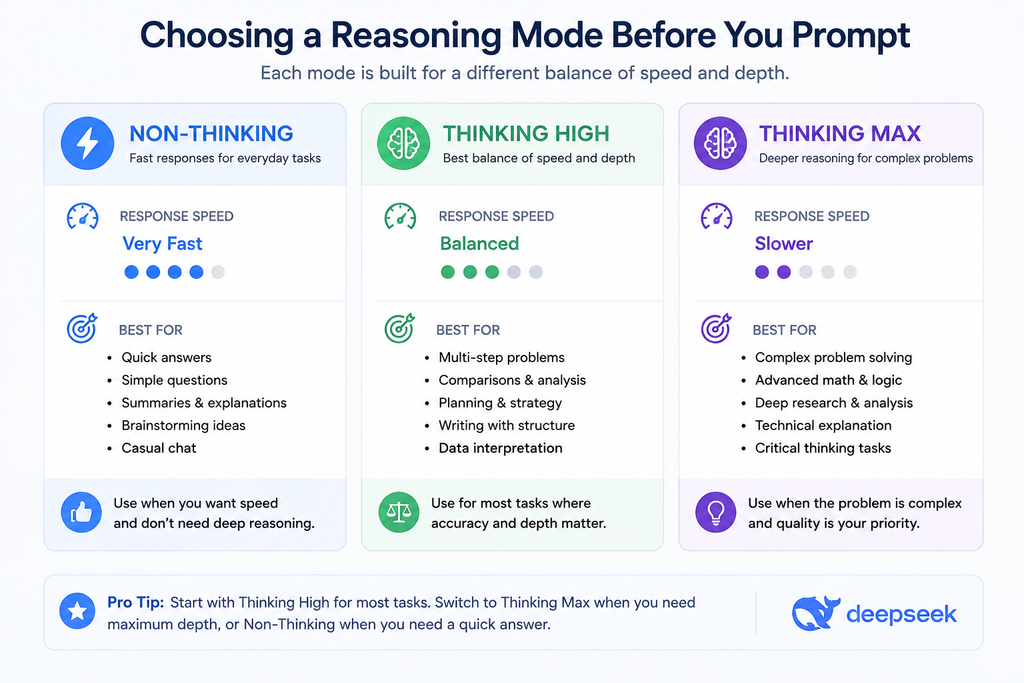
DeepSeek’s current models offer selectable reasoning effort — typically presented as Non-Thinking, Thinking High, and Thinking Max modes, depending on which model version you’re using. This isn’t a cosmetic setting. Non-Thinking mode responds quickly and is well suited to straightforward requests — drafting an email, summarizing a short passage, answering a factual question. Thinking High and Thinking Max allocate more computation to working through a problem step by step before answering, which measurably improves output on math, multi-step logic, and complex coding tasks, at the cost of a slower response. As a rule of thumb: reach for a thinking mode whenever a prompt below involves multiple steps of reasoning, code that needs to actually run correctly, or a math problem with more than one moving part — and skip it for anything conversational or purely generative.
1. Coding and Debugging Prompts (10)
- “Review this function for bugs, edge cases, and potential failure points: [paste code]. Explain each issue and suggest a fix.”
- “Here’s a Python script that’s throwing this error: [paste error]. Here’s the code: [paste code]. Diagnose the cause and provide a corrected version.”
- “Refactor this function to be more readable and efficient without changing its behavior: [paste code]. Explain each change you made.”
- “Write unit tests for this function, covering normal cases, edge cases, and invalid input: [paste code].”
- “Convert this code from [language A] to [language B], preserving the same logic and structure: [paste code].”
- “Explain what this code does, line by line, assuming I know [language] basics but haven’t seen this specific pattern before: [paste code].”
- “Here’s my database schema: [paste schema]. Write a SQL query that [describe the exact result needed].”
- “Act as a senior code reviewer. Review this pull request diff for maintainability, security, and performance issues: [paste diff].”
- “Write a regular expression that matches [describe the pattern], and explain what each part of it does.”
- “Here’s a stack trace from a production error: [paste trace]. Based on this codebase context: [paste relevant files], identify the likely root cause.”
2. Long-Document and Codebase Analysis Prompts (10)
- “Here is an entire research paper: [paste full text]. Summarize its methodology, findings, and limitations in plain language.”
- “Here is my full project’s file structure and key modules: [paste content]. Identify any architectural inconsistencies or duplicated logic across files.”
- “Here is a 40-page contract: [paste full text]. List every clause that includes a financial obligation, deadline, or penalty.”
- “Here is a full customer feedback export: [paste content]. Identify the five most common themes and rank them by frequency.”
- “Here is an entire book chapter: [paste text]. Create a structured outline capturing every major argument and supporting example.”
- “Here is a full legal case document: [paste text]. Summarize the key facts, the ruling, and the reasoning behind it.”
- “Here is a long meeting transcript: [paste transcript]. Extract every decision made and every action item assigned, with who owns each one.”
- “Here is my entire codebase’s error-handling logic across these files: [paste files]. Identify any inconsistent patterns in how errors are caught and logged.”
- “Here is a full year of my company’s board meeting notes: [paste content]. Summarize how our stated priorities shifted over the year.”
- “Here is an entire textbook chapter: [paste text]. Generate 15 quiz questions covering the material, ranging from basic recall to applied reasoning.”
3. Math and Logical Reasoning Prompts (10)
- “Solve this problem step by step, showing your reasoning at each stage rather than just the final answer: [paste problem].”
- “Here’s a probability question: [describe scenario]. Walk through the correct approach and explain why a naive calculation would give the wrong answer.”
- “Prove or disprove this mathematical claim, showing full reasoning: [paste claim].”
- “Here’s a logic puzzle: [paste puzzle]. Solve it and explain the deductive steps that rule out each incorrect possibility.”
- “Here’s a set of financial figures: [paste numbers]. Calculate the break-even point and show the formula used at each step.”
- “Here’s a statistics dataset summary: [paste summary]. Determine which statistical test would be appropriate and explain why.”
- “Here’s an optimization problem: [describe constraints and goal]. Work through it step by step and explain the tradeoffs at each decision point.”
- “Check this mathematical proof for errors: [paste proof]. Identify any step where the logic doesn’t actually follow.”
- “Here’s a word problem involving rates and time: [paste problem]. Solve it and explain the reasoning in a way a student could follow.”
- “Here’s a set of conflicting data points: [paste data]. Reason through which conclusion the evidence actually supports, and note what remains uncertain.”
4. Data Analysis and Research Summarization Prompts (10)
- “Here’s a CSV summary of sales data by region and month: [paste data]. Identify the three most significant trends and explain what might be driving each.”
- “Compare these two datasets and identify meaningful differences, not just surface-level ones: [paste data A], [paste data B].”
- “Here’s a survey results summary: [paste data]. Identify any responses that seem contradictory and suggest what might explain the discrepancy.”
- “Here’s a list of academic paper abstracts on [topic]: [paste abstracts]. Group them by methodology and summarize the overall state of research.”
- “Here’s raw customer churn data: [paste data]. Propose three hypotheses for what’s driving the churn, ranked by how well the data supports each.”
- “Here’s a competitor pricing table: [paste data]. Identify pricing gaps or inconsistencies worth investigating.”
- “Here’s a dataset with missing values: [paste data]. Suggest an appropriate way to handle the gaps and explain the tradeoffs of each option.”
- “Summarize this industry report into five key takeaways relevant to a small business owner: [paste report].”
- “Here’s a set of A/B test results: [paste data]. Determine whether the difference is likely meaningful or could plausibly be noise.”
- “Here’s a dataset of customer complaints with timestamps: [paste data]. Identify whether complaint volume correlates with any specific event or period.”
5. Business and Strategy Reasoning Prompts (10)
- “Here’s my business situation: [describe context]. Identify the three biggest risks to this plan and how likely each one is to materialize.”
- “Compare these two strategic options for [decision], weighing the tradeoffs of each rather than just listing pros and cons: [describe options].”
- “Here’s my current pricing structure: [describe it]. Identify where it might be leaving money on the table or discouraging upgrades.”
- “Act as a skeptical investor reviewing this business plan: [paste plan]. What questions would you ask before deciding to invest?”
- “Here’s a summary of my competitor’s recent moves: [describe them]. Reason through what strategic goal is most likely driving this pattern.”
- “Here’s my current org structure: [describe it]. Identify potential bottlenecks or unclear ownership as the team grows to [target size].”
- “Walk through the second-order consequences of this decision before I make it: [describe decision].”
- “Here’s my customer acquisition funnel data: [paste numbers]. Identify the stage with the biggest drop-off and reason through likely causes.”
- “Act as a devil’s advocate and argue against this plan I’m considering: [describe plan]. Be specific, not just cautious.”
- “Here’s my current runway and burn rate: [describe numbers]. Reason through what changes would meaningfully extend it.”
6. Writing and Content Prompts (10)
- “Write a 150-word introduction for an article about [topic], leading with a specific insight rather than a generic opening.”
- “Rewrite this paragraph to be more concise without losing any meaning: [paste text].”
- “Write a professional but warm email declining this request, while leaving the door open for future collaboration: [describe request].”
- “Turn these rough notes into a clearly structured section: [paste notes], keeping my original points intact.”
- “Write three alternative headlines for this article, each emphasizing a different angle: [paste article summary].”
- “Proofread this text for grammar and clarity issues only, without changing my tone or word choices: [paste text].”
- “Write a short bio for [name/role] based on this background information: [paste details].”
- “Summarize this article into a 3-sentence version suitable for a newsletter blurb: [paste article].”
- “Write a polite but firm follow-up message for an unanswered proposal, without sounding pushy: [describe context].”
- “Adjust the tone of this message to sound more [formal/casual/confident], without changing the actual content: [paste message].”
7. Study and Learning Prompts (10)
- “Explain [concept] to me, and here’s what I already know: [describe background]. Only explain the parts I haven’t already covered.”
- “Create 10 flashcard-style question-and-answer pairs covering this material: [paste notes].”
- “Here’s my understanding of [concept]: [describe it]. Point out anything I’ve gotten wrong or oversimplified.”
- “Explain the difference between [concept A] and [concept B] with a concrete example for each.”
- “Create a study schedule for learning [topic] over [timeframe], broken into weekly milestones.”
- “Quiz me on [topic] with five questions of increasing difficulty, and explain the correct answer after each one.”
- “Here’s a passage from a textbook: [paste text]. Rewrite it in simpler language while keeping every key fact intact.”
- “Explain [concept] using an analogy to something from everyday life.”
- “Here’s a practice problem I got wrong: [paste problem and my answer]. Explain where my reasoning went wrong.”
- “Create a one-page summary of [topic] suitable for reviewing right before an exam.”
8. Agentic and Automation Prompts (10)
- “Here’s a multi-step task: [describe task]. Break it into a sequence of discrete steps I could automate or delegate individually.”
- “Write a script that automates [describe repetitive task], and explain any assumptions it makes about the input format.”
- “Here’s my current manual workflow for [task]: [describe steps]. Identify which steps could realistically be automated.”
- “Design a simple decision tree for handling [type of request] without needing a human to review every case.”
- “Here’s an API response format: [paste example]. Write a script that extracts [specific fields] and formats them as [desired output].”
- “Here’s a recurring task I do weekly: [describe it]. Draft a checklist that ensures nothing gets missed if someone else has to do it.”
- “Write a script that monitors [describe condition] and sends an alert when it’s met.”
- “Here’s a folder of inconsistent filenames: [paste example list]. Write a script that renames them to a consistent format: [describe format].”
- “Design a simple approval workflow for [process], including who should review what and in what order.”
- “Here’s a batch of raw data I need cleaned: [paste sample]. Write a script that standardizes [describe the specific formatting issue].”
9. Translation and Language Prompts (10)
- “Translate this text into [language], preserving the tone and register of the original: [paste text].”
- “Here’s a phrase that doesn’t translate literally into [language]: [paste phrase]. Suggest the closest natural equivalent.”
- “Review this translated text for accuracy and natural phrasing: [paste original], [paste translation].”
- “Explain the difference in formality between these two ways of saying [phrase] in [language].”
- “Translate this business email into [language], adjusting for appropriate professional tone in that language’s business culture.”
- “Here’s a product description in [language]: [paste text]. Translate it into [target language] in a way that would resonate with local buyers, not just a literal translation.”
- “Explain this idiom in [language] and suggest the closest English equivalent, if one exists.”
- “Translate this technical document into [language], keeping all technical terms consistent throughout.”
- “Here’s a short story in [language]: [paste text]. Translate it while preserving the narrative voice and pacing.”
- “Check this multilingual product listing for consistency: [paste both versions]. Flag anything that doesn’t match in meaning between the two.”
10. Personal Productivity and Planning Prompts (10)
- “Here’s my task list for the week: [paste list]. Help me prioritize it based on urgency and actual impact, not just order given.”
- “Here’s my calendar for tomorrow: [describe it]. Identify any scheduling conflicts or unrealistic time estimates.”
- “Break this large goal into a realistic month-by-month plan: [describe goal].”
- “Here’s how I spent my time this week: [describe or paste log]. Identify where the biggest time drains are.”
- “Help me plan a decision-making framework for choosing between these options: [describe options], based on criteria I actually care about: [list criteria].”
- “Draft a simple daily routine that fits around this fixed schedule: [describe fixed commitments].”
- “Here’s a project with this deadline: [describe project and date]. Work backward to create a milestone schedule.”
- “Help me think through the pros and cons of this decision without pushing me toward either option: [describe decision].”
- “Here’s a recurring source of stress in my schedule: [describe it]. Suggest a few concrete adjustments, not just general advice.”
- “Summarize this week’s key takeaways from my notes into three action items for next week: [paste notes].”
What Makes DeepSeek Genuinely Different to Prompt
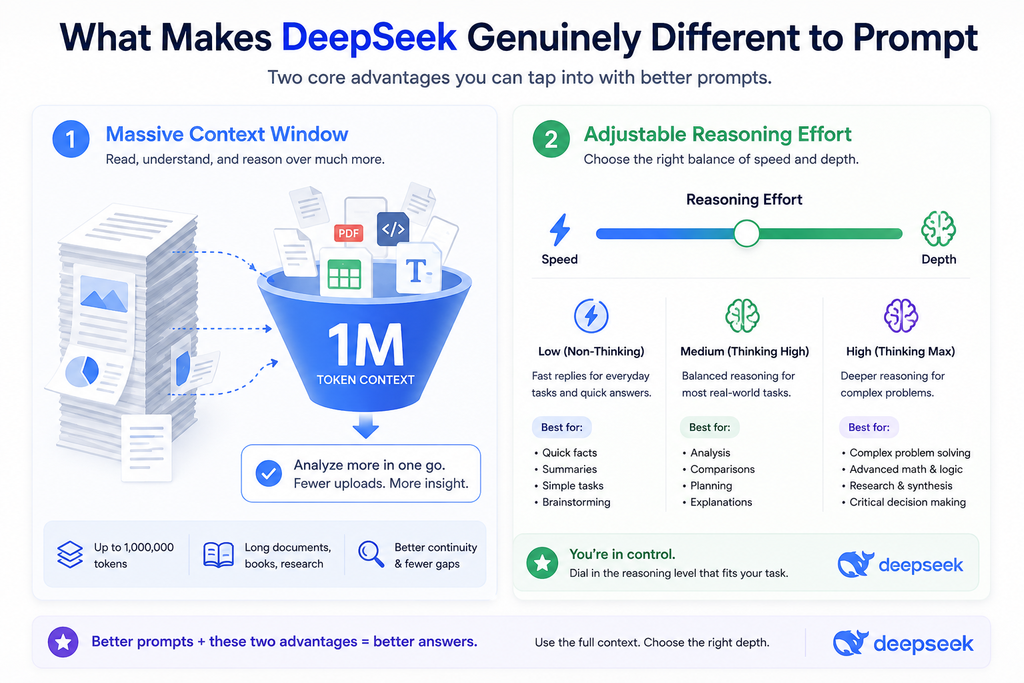
Two things separate prompting DeepSeek from prompting most other chat assistants. First, the context window: at up to a million tokens on the current flagship models, you can paste in genuinely large material — an entire book chapter, a full contract, a whole codebase’s worth of files — in a single prompt, which most of the long-document prompts above are built to take advantage of. Second, the selectable reasoning effort: rather than getting one fixed quality level regardless of task, you can deliberately trade speed for depth on the problems that need it, which is particularly valuable for the math and coding prompts in this library.
A Note on Cost and Data Handling
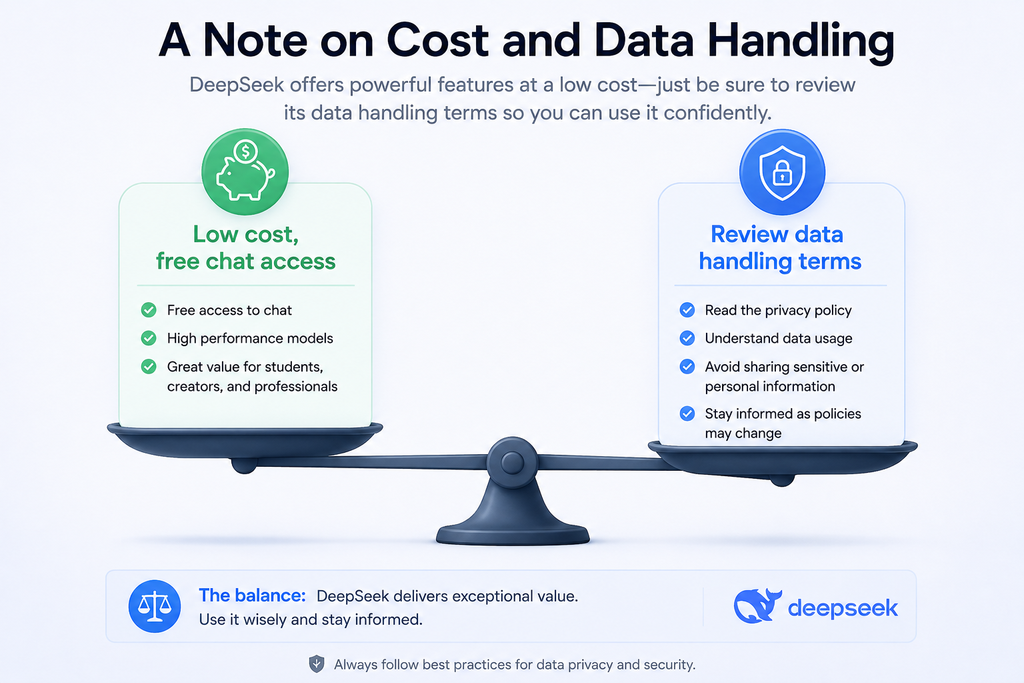
Part of DeepSeek’s appeal is genuinely low cost — its API pricing has consistently undercut Western frontier models by a wide margin, and its consumer chat interface is free to use. That tradeoff is worth being clear-eyed about: DeepSeek is a Chinese company, and its terms of service and data handling practices differ from US and European providers in ways worth reading before sending sensitive business, legal, or personal information through it. For coding, math, research summarization, and general writing tasks using non-sensitive material, this is rarely a practical concern. For anything involving confidential business data, personally identifiable information, or content with legal sensitivity, it’s worth checking DeepSeek’s current privacy policy directly and considering whether a different tool or a self-hosted open-weight deployment better fits your requirements.
What the Evidence Suggests
Across current technical comparisons, DeepSeek’s actual competitive edge in 2026 isn’t generic chat quality — it’s a specific combination of an unusually large context window, strong coding and mathematical reasoning performance, and a cost structure that undercuts nearly every Western alternative by a significant margin. Prompts that lean into that combination — pasting in large documents, tackling multi-step reasoning with a thinking mode enabled, or handling agentic coding tasks — tend to show DeepSeek at its best. Prompts that ignore those strengths and treat it as a generic chatbot largely produce results comparable to any other capable model, which is useful to know when deciding which tasks are actually worth routing to DeepSeek specifically.