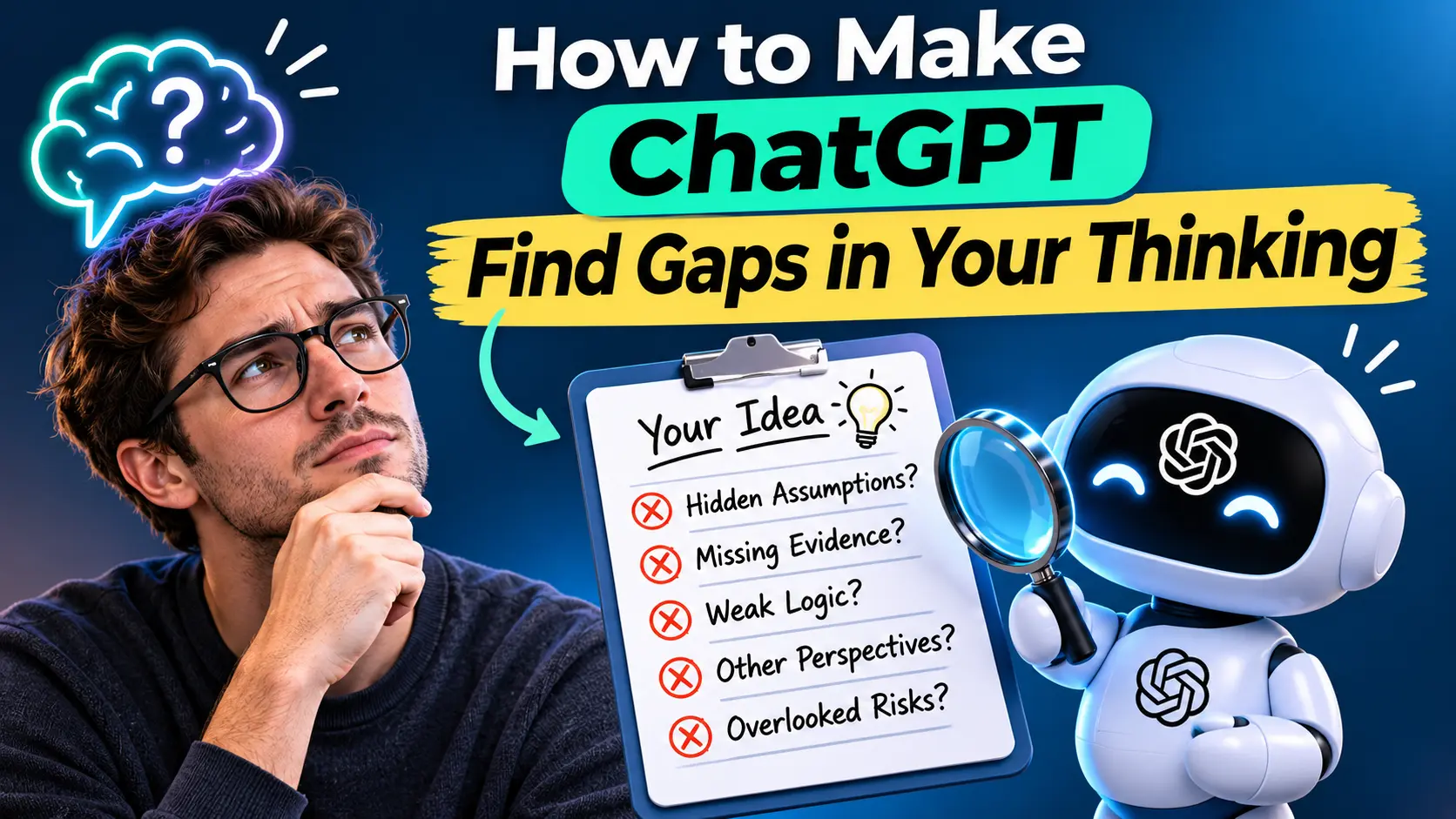
How to Make ChatGPT Find Gaps in Your Thinking
Learn how to use ChatGPT to uncover blind spots, challenge assumptions, test your reasoning, and find weaknesses in your ideas with practical prompts.
Have you ever shared an idea with ChatGPT, received a detailed and encouraging response, and walked away feeling that your thinking was solid?
There is one problem: the response may have helped you develop your idea without properly testing whether the idea was right in the first place.
Perhaps you overlooked an important assumption. Maybe your conclusion depends on evidence you haven’t checked. Or you considered only the benefits while ignoring the risks.
This is where ChatGPT can become more useful.
Instead of asking it to improve your idea, you can ask it to examine your thinking, challenge your assumptions, identify missing information, and present arguments you may not have considered.
The trick is to give it a specific job.
In this guide, you’ll learn how to make ChatGPT find gaps in your thinking, use practical prompts for different situations, and evaluate its criticism without blindly accepting everything it says.
The quickest way to make ChatGPT challenge your thinking
Start with this copy-and-paste prompt:
The Thinking Gap Finder Prompt
You are my critical thinking partner. I will share an idea, plan, argument, decision, or assumption.
Do not automatically agree with me or simply improve my idea. Examine it carefully and help me identify:
- Hidden assumptions I may be treating as facts.
- Important information or evidence that is missing.
- Weak reasoning, contradictions, or logical gaps.
- Alternative explanations or perspectives I may have overlooked.
- Risks, unintended consequences, and possible failure points.
- Strong counterarguments someone knowledgeable might raise.
- Questions I should answer before reaching a conclusion.
Distinguish between verified facts, reasonable inferences, and speculation. Do not invent weaknesses just to appear critical.
Prioritize the three most important gaps. Explain why each matters and suggest how I can investigate or address it.
If you need important context before evaluating my thinking, ask me concise clarifying questions first.
Be direct, constructive, and intellectually honest. Your goal is to improve the quality of my thinking, not to win an argument.
How to use it: Paste the prompt into ChatGPT, then share your idea underneath it. You can use it for a business plan, career decision, research argument, content strategy, product idea, or almost any situation where you want a second perspective.
The most important instruction is not simply “find flaws.” It is “do not invent weaknesses just to appear critical.” You want useful criticism, not a list of objections created for the sake of sounding intelligent.
Why ChatGPT may not point out the weaknesses in your idea automatically
Imagine asking:
“Is this a good business idea? I want to start an online store selling affordable skincare products.”
ChatGPT might respond with market opportunities, branding suggestions, marketing strategies, and possible ways to attract customers.
That information could be useful. But it might not examine some of the most important questions:
- What makes this store different from existing skincare retailers?
- How will customers decide to trust an unfamiliar brand?
- What evidence suggests there is enough demand?
- Can the business compete after advertising, delivery, and product costs?
- What happens if customer acquisition becomes too expensive?
The issue is not necessarily that ChatGPT cannot discuss these questions. Your original request simply did not make critical evaluation its main objective.
OpenAI’s prompting guidance recommends giving clear, specific instructions and enough context for the model to understand the task. It also recommends reviewing responses and refining prompts when necessary. See OpenAI’s prompting best practices.
There is another relevant concern: sycophancy, or overly agreeable AI behavior.
In May 2025, OpenAI published an explanation of a GPT-4o update that had made ChatGPT noticeably more agreeable than intended. The company described how the model’s responses could validate users’ doubts, reinforce anger, or encourage impulsive actions. OpenAI also explained the steps it was taking to address the issue.
This does not mean every positive response from ChatGPT is sycophantic. It does show why users should not treat agreement as evidence that an idea is correct.
Read OpenAI’s explanation of sycophancy.
The practical lesson is simple: if you want a serious examination of your thinking, explicitly request one.
First, understand what a gap in your thinking actually means
A thinking gap is something missing, overlooked, assumed, or insufficiently examined in the way you reached a conclusion.
It does not always mean your idea is wrong.
Sometimes your conclusion is reasonable, but the evidence supporting it is incomplete. Sometimes you have identified the problem correctly but overlooked a practical obstacle. In other cases, you may be considering only one possible explanation.
Here are seven types of gaps ChatGPT can help you examine.
| Type of gap | What it means | Example |
|---|---|---|
| Hidden assumptions | Beliefs treated as established facts | Assuming customers will pay for a new product |
| Missing evidence | Claims without sufficient support | Believing demand exists without customer research |
| Logical gaps | A conclusion does not follow from the available reasoning | Assuming more website traffic automatically means more sales |
| Alternative perspectives | Other explanations or viewpoints are missing | Considering only the customer’s perspective, not the supplier’s |
| Overlooked risks | Possible problems have not been considered | Ignoring delivery costs or competition |
| Contradictions | Different parts of an argument conflict | Wanting premium positioning while competing only on price |
| Missing questions | Important issues remain unanswered | Not knowing how success will be measured |
You can ask ChatGPT to review all seven areas, but you will often get more useful feedback by focusing on one or two at a time.
READ ALSO – How to Make ChatGPT Challenge Your Assumptions (Prompts That Work)
Let’s look at how.
7 ChatGPT prompts to find gaps in your thinking
Each prompt below has a different purpose. You do not need to use all seven for every idea.
1. Find hidden assumptions
Sometimes the biggest weakness in an idea is something you have accepted without questioning it.
For example, a person planning to launch a paid online course might assume that people who follow their social media account will also buy the course.
That assumption could be wrong.
Use this prompt:
Prompt:
Review the idea below and identify the assumptions I am making, including assumptions I may not have noticed.
Separate them into:
- Assumptions that are supported by evidence.
- Assumptions that are reasonable but unverified.
- Assumptions that are weak or potentially incorrect.
For each important assumption, explain why it matters and what information could help me test it.
Do not assume that an unverified assumption is automatically false.
My idea: [Paste your idea here]
When to use it: Before launching a product, starting a project, making a business decision, or committing resources to a plan.
2. Identify missing evidence
A confident argument is not necessarily a well-supported argument.
You might believe that a marketing campaign will work because similar campaigns have succeeded elsewhere. But do you have evidence that the same approach will work for your audience, budget, and market?
Use this prompt:
Prompt:
Examine the argument or conclusion below.
Identify the claims that need supporting evidence. For each claim:
- Explain what evidence would strengthen it.
- Identify what information is currently missing.
- Distinguish between facts, assumptions, and opinions.
- Suggest how I could verify the important claims.
- Tell me which missing evidence could change the conclusion.
Do not invent sources, statistics, or research findings.
My argument or conclusion: [Paste it here]
When to use it: Research, academic writing, business proposals, presentations, marketing plans, and decisions involving factual claims.
3. Challenge my logic
Sometimes the information is correct, but the reasoning connecting one point to another is weak.
Consider this example:
“Our website traffic increased by 40% last month, so our marketing strategy is successful.”
That conclusion may be premature. Traffic could have increased while conversions, revenue, or lead quality declined.
Use this prompt:
Prompt:
Act as a critical reasoning reviewer.
Examine the logic behind my argument. Identify:
- Conclusions that do not follow from the evidence.
- Logical jumps or unsupported connections.
- Contradictions between different statements.
- Possible reasoning errors.
- Other explanations that could account for the same observations.
For every weakness you identify, explain your reasoning and provide a more defensible way to express the argument.
Do not criticize a statement simply because you disagree with it.
My argument: [Paste it here]
When to use it: Evaluating business performance, preparing an argument, making strategic decisions, or checking whether your conclusion is justified.
4. Show me alternative perspectives
People naturally interpret situations through their own experiences and priorities.
A business owner might judge a product based on profitability. A customer might judge the same product based on convenience, trust, and price.
Neither perspective is automatically complete.
Use this prompt:
Prompt:
Analyze my idea from at least five different perspectives.
Consider the viewpoints of:
- Someone who strongly supports the idea.
- Someone who disagrees with it.
- A person directly affected by the decision.
- A subject-matter expert.
- Someone with different priorities or incentives.
Explain what each perspective might notice that I have overlooked.
Do not create artificial disagreements. Focus on meaningful differences in priorities, evidence, and interpretation.
My idea or decision: [Paste it here]
When to use it: Product development, leadership, negotiations, content planning, business strategy, and decisions involving other people.
5. Identify risks and unintended consequences
A plan can look excellent when you consider only its expected benefits.
The weaknesses often become visible when you ask what could go wrong.
Use this prompt:
Prompt:
Review my plan as a risk analyst.
Identify the most important ways it could fail, including:
- Risks I have overlooked.
- Dependencies that could create problems.
- Unintended consequences.
- Financial, operational, or reputational risks.
- Factors outside my control.
- Warning signs that would indicate the plan is not working.
Rank the risks by potential impact and explain what I could do to reduce or monitor them.
Do not exaggerate unlikely risks. Distinguish realistic concerns from speculative possibilities.
My plan: [Paste it here]
When to use it: Business launches, investments, project planning, career changes, marketing campaigns, and major commitments.
6. Build the strongest counterargument
One of the best ways to test an idea is to understand the strongest reasonable argument against it.
This is different from asking ChatGPT to disagree with everything you say.
Use this prompt:
Prompt:
Construct the strongest reasonable counterargument to my position.
Do not use weak objections or misrepresent my argument.
First, summarize my position fairly. Then explain the strongest objections, the evidence or reasoning behind them, and which parts of my position are most vulnerable.
Finally, identify what evidence would help resolve the disagreement.
If my position is already well supported in a particular area, acknowledge that instead of forcing a disagreement.
My position: [Paste it here]
When to use it: Debates, opinion articles, research papers, business proposals, negotiations, and decisions where you want to understand the opposing case.
7. Find the questions I haven’t thought to ask
This is useful when you know you have an incomplete understanding of a situation but cannot identify exactly what is missing.
Use this prompt:
Prompt:
Review the situation below and identify the important questions I have not considered.
Think about missing context, untested assumptions, possible consequences, dependencies, alternative explanations, and information I should obtain before deciding.
Prioritize the questions by how much their answers could change my understanding or decision.
Ask no more than five questions in the first round. Do not ask questions that are irrelevant or whose answers can reasonably be inferred.
Wait for my answers before completing your evaluation.
Situation: [Explain it here]
When to use it: Early-stage planning, unfamiliar subjects, complex decisions, and situations where you are not sure what you do not know.
A practical example: using ChatGPT to examine a business idea
Prompts become much easier to understand when you see how they work with a real scenario.
Suppose someone shares this idea:
“I want to start a blog about AI tools. AI is becoming popular, and I think I can attract a large audience by publishing articles about ChatGPT and other AI products.”
A basic ChatGPT response might suggest article topics, publishing frequency, SEO strategies, and ways to monetize the blog.
But let’s use the Thinking Gap Finder approach.
Step 1: Ask ChatGPT to identify assumptions
It might identify assumptions such as:
- Interest in AI tools will translate into consistent search demand.
- The blog can compete with established technology websites.
- Readers will return even though AI products change frequently.
- Publishing more articles will necessarily produce more traffic.
These are hypotheses to investigate, not established facts.
Step 2: Ask it to examine missing evidence
The next question is not simply whether AI is popular.
You need evidence about the specific opportunity:
- Which AI topics have identifiable search demand?
- How competitive are the relevant search results?
- What questions are existing articles failing to answer?
- Can the blog provide useful original examples or expertise?
- What would make readers trust the information?
Step 3: Ask it to identify risks
Possible risks include:
- Product features changing after publication.
- Established websites dominating competitive keywords.
- Articles becoming outdated quickly.
- Publishing generic content that offers little additional value.
- Relying too heavily on search traffic from a single source.
Step 4: Ask what would change the decision
Finally, ask:
“What evidence would convince you that this blog is worth starting, and what evidence would make you reconsider?”
This question moves the conversation beyond encouragement.
It gives you criteria to evaluate before investing time and money.
The important distinction is that ChatGPT has not proven the blog will succeed or fail. It has helped organize the investigation you need to conduct.
The GAP method: a simple framework for reviewing any idea
If you do not want to remember seven separate prompts, use this four-part framework.
I call it the GAP method because it gives you a repeatable way to inspect your thinking.
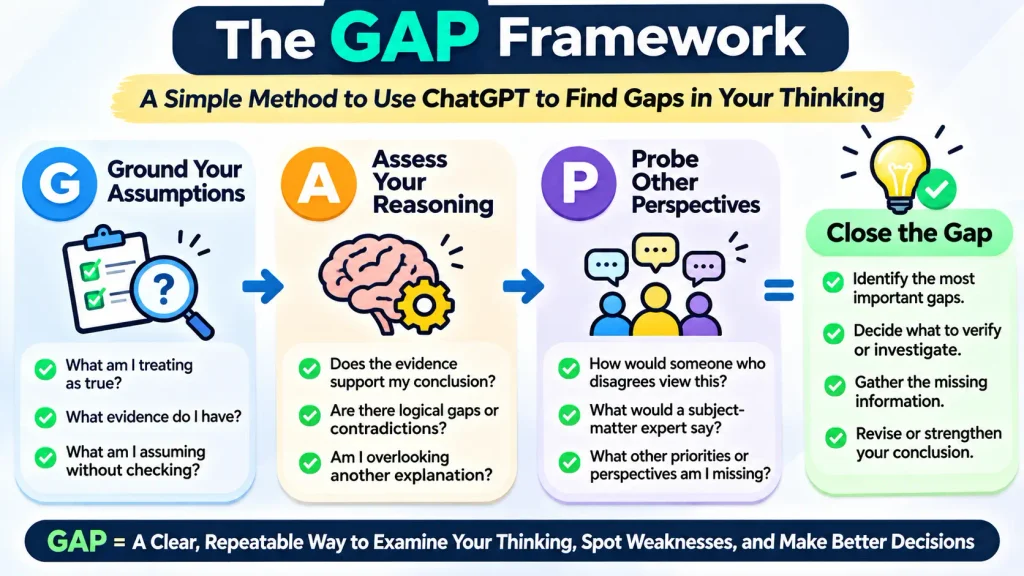
G — Ground your assumptions
Ask what you are treating as true.
- Which beliefs support my conclusion?
- What evidence do I have?
- What am I assuming without checking?
A — Assess your reasoning
Examine how you reached the conclusion.
- Does the evidence support the conclusion?
- Are there contradictions?
- Am I overlooking another explanation?
P — Probe other perspectives
Look beyond your own point of view.
- What would a knowledgeable critic say?
- Who is affected by this decision?
- What alternatives have I ignored?
Close the gap — Identify what to do next
Turn criticism into action.
- What should I verify?
- What information should I collect?
- What should I change?
- Which unanswered question matters most?
The final step is essential. Finding weaknesses is useful only when it helps you investigate, revise, or make a better-informed decision.
How to get more useful criticism from ChatGPT
A well-written prompt helps, but the quality of the material you provide matters too.
Here are five ways to improve the review.
Give ChatGPT the reasoning behind your idea
Do not share only your conclusion.
Instead of:
“I think I should leave my job and start a business.”
Share:
“I am considering leaving my job to start a business. I have six months of savings, a small number of potential customers, and no confirmed revenue yet. I want to understand whether my reasoning is sound and what I may be overlooking.”
The second version gives ChatGPT something meaningful to evaluate.
Ask it to separate facts from assumptions
This prevents different types of statements from being treated as equally reliable.
For example:
| Statement | Classification |
|---|---|
| I have spoken to 10 potential customers | Reported fact, assuming accurate |
| All 10 will become paying customers | Assumption |
| Similar products exist in the market | Verifiable claim |
| My product will be more successful | Prediction |
You can ask ChatGPT to create this distinction before it evaluates your conclusion.
Ask for evidence behind its criticism
If ChatGPT says your business plan has weak market research, ask:
“What specifically is missing from the market research? What evidence would be sufficient to address this weakness?”
This forces the conversation toward concrete information rather than vague criticism.
For external factual claims, ask it to provide reliable sources you can independently check.
Ask it to rank the problems
Not every weakness deserves equal attention.
A missing detail in your presentation format is less important than an untested assumption that determines whether your business can make money.
Try:
“Rank the five weaknesses you identified by their potential impact on my final decision. Explain why the first three deserve attention before the others.”
This makes the feedback easier to act on.
Challenge ChatGPT’s criticism too
Do not assume its objections are correct simply because they sound convincing.
You can ask:
“Review your own criticism. Which objections are strongly supported by the information I provided, which depend on assumptions, and which might be incorrect?”
That follow-up is important. The reviewer itself needs to be reviewed.
How to make ChatGPT find gaps in different situations
The same technique can be adapted to different kinds of work.
| Situation | What ChatGPT should examine |
|---|---|
| Business idea | Demand, competition, costs, assumptions, and risks |
| Career decision | Priorities, opportunity costs, alternatives, and long-term implications |
| Research paper | Evidence, argument structure, methodology, and limitations |
| Content strategy | Audience needs, search intent, originality, and missing topics |
| Marketing campaign | Customer assumptions, positioning, conversion barriers, and measurement |
| Personal decision | Priorities, trade-offs, uncertainty, and possible consequences |
| Product development | User needs, usability, differentiation, and adoption risks |
For example, a content creator could ask:
“Review my content strategy as a skeptical SEO editor. Identify topics that do not match the audience’s search intent, assumptions about search demand that need verification, missing subtopics, weak differentiation, and claims that require evidence. Prioritize the three biggest problems and suggest how to investigate them.”
A student could instead ask:
“Review my essay argument. Identify unsupported claims, missing counterarguments, gaps in reasoning, and evidence that does not adequately support my conclusion. Do not rewrite the essay yet. First show me what needs improvement.”
The technique stays the same. The evaluation criteria change with the task.
Can you make ChatGPT challenge your thinking by default?
Yes. You can add a preference to your Custom Instructions or, if you work within a ChatGPT Project, add project-specific instructions.
For example:
“Act as a constructive critical-thinking partner. Do not automatically agree with my opinions or assumptions. When I share an idea, argument, or decision, identify important weaknesses, missing evidence, alternative perspectives, and possible risks when relevant. Distinguish facts from assumptions and explain uncertainty. Ask clarifying questions if important context is missing. Be respectful, direct, and constructive. Do not invent objections simply to disagree with me.”
OpenAI documents Custom Instructions as a way to tell ChatGPT what it should consider when responding. It also documents project instructions that can define behavior within a particular project.
Useful references:
You can use a general instruction across conversations or keep a more specialized critical-review instruction inside a project dedicated to research, writing, or decision-making.
Remember that instructions guide the model’s behavior; they do not guarantee that it will catch every weakness.
Common mistakes when asking ChatGPT to find gaps
1. Asking it to disagree with everything
A prompt such as “Always disagree with me” encourages opposition, not accuracy.
Some of your ideas may be correct. You want ChatGPT to identify weaknesses where they exist, not manufacture them.
Better approach: Ask for evidence-based criticism and tell it to acknowledge well-supported points.
2. Providing too little context
If you share only a one-line idea, ChatGPT has limited information to examine.
It may fill the gaps with assumptions of its own.
Better approach: Explain your objective, reasoning, constraints, available evidence, and what you have already considered.
3. Treating every objection as a real problem
ChatGPT might identify a possible risk that is technically conceivable but extremely unlikely.
A possibility is not automatically a meaningful risk.
Better approach: Ask it to rank objections by likelihood, impact, and available evidence. Treat estimates as provisional unless supported by data.
4. Asking for criticism without asking for next steps
A long list of weaknesses can leave you more confused than before.
Better approach: Ask ChatGPT to recommend what to investigate first and what evidence could resolve each major concern.
5. Accepting confident-sounding criticism without verification
ChatGPT can make mistakes while evaluating your reasoning, just as it can when answering factual questions.
Research on generative AI use supports the need for active evaluation. A 2025 CHI Conference study by Microsoft researchers surveyed 319 knowledge workers and found that greater confidence in generative AI was associated with less reported critical-thinking effort. The study examined self-reported experiences, so it should not be interpreted as proof that AI always reduces critical thinking.
You can read the study here: The Impact of Generative AI on Critical Thinking.
Better approach: Verify important factual claims, examine the reasoning, and use independent evidence before making consequential decisions.
What ChatGPT cannot reliably do for you
There is an important limit to this technique.
ChatGPT can help you examine an argument, generate counterarguments, organize competing explanations, and identify information that appears to be missing.
But it does not automatically know everything you have overlooked.
Its evaluation depends on the information available in the conversation, the instructions you provide, and the quality of its response. It may miss a relevant risk, misunderstand your circumstances, or present an incorrect objection as if it were well founded.
It can also repeat a weak assumption in a more polished form.
For that reason:
- Verify important factual claims against reliable sources.
- Seek qualified professional advice for high-stakes medical, legal, or financial decisions.
- Do not share confidential business or personal information unless you are comfortable with the applicable data and privacy settings.
- Treat AI-generated counterarguments as candidates for examination, not final judgments.
- Use your own knowledge and judgment to decide which criticisms deserve attention.
The purpose is not to outsource your thinking. It is to make your thinking more deliberate.
Frequently asked questions
How do I make ChatGPT challenge my ideas instead of agreeing with me?
Give ChatGPT an explicit instruction to act as a critical thinking partner. Ask it to examine hidden assumptions, missing evidence, weak reasoning, alternative perspectives, and risks. Also tell it not to invent objections just to disagree with you.
What is the best ChatGPT prompt for finding blind spots?
Use a prompt that asks ChatGPT to identify assumptions you may have overlooked, evidence you have not considered, alternative explanations, and possible consequences. Ask it to prioritize the most important gaps and explain how you can investigate them.
Can ChatGPT identify logical fallacies?
ChatGPT can help identify possible reasoning errors, contradictions, unsupported conclusions, and common logical fallacies in an argument. However, its assessment can be incorrect, so examine the explanation rather than accepting the label automatically.
Can ChatGPT help me make better decisions?
It can help you compare options, examine trade-offs, identify missing information, and consider alternative perspectives. The quality of the analysis depends on the context and evidence you provide. The final decision remains yours.
How do I stop ChatGPT from simply agreeing with me?
Ask it to evaluate your reasoning independently rather than validate your conclusion. You can also add instructions such as “Do not assume my position is correct” and “Distinguish between supported claims and unverified assumptions.”
Can I use ChatGPT for critical thinking in research?
Yes. You can ask it to review research questions, identify gaps in an argument, examine methodology, generate counterarguments, and highlight claims that need stronger evidence. Verify sources and research findings independently.
Is ChatGPT always correct when it finds a weakness in my thinking?
No. It can identify useful issues, but it can also misunderstand context or generate unsupported criticism. Treat its feedback as a starting point for investigation rather than proof that your reasoning is wrong.
The real value of ChatGPT is not always in the answers it gives
ChatGPT is useful when it helps you develop an idea. But it can be even more useful when it helps you examine the idea before you commit to it.
The next time you have a business plan, research argument, career decision, or creative idea, do not ask only:
“How can I improve this?”
Ask:
“What am I missing? What am I assuming? What evidence could prove me wrong?”
Then examine the answers carefully.
The goal is not to make ChatGPT disagree with you. It is to create a conversation in which your ideas are tested rather than simply reinforced.
Use ChatGPT to find the gaps. Use evidence and your own judgment to decide what to do about them.