
Cold email remains one of the most persistent tools in professional life — used by job seekers, freelancers, sales teams and small businesses alike to open doors that would otherwise stay shut. It is also, by most accounts, spectacularly inefficient: industry estimates commonly cited by marketers place average cold email reply rates in the single digits. The arrival of large language models such as ChatGPT was meant to change this calculus, promising personalised, well-crafted outreach at a scale no individual could manage by hand.
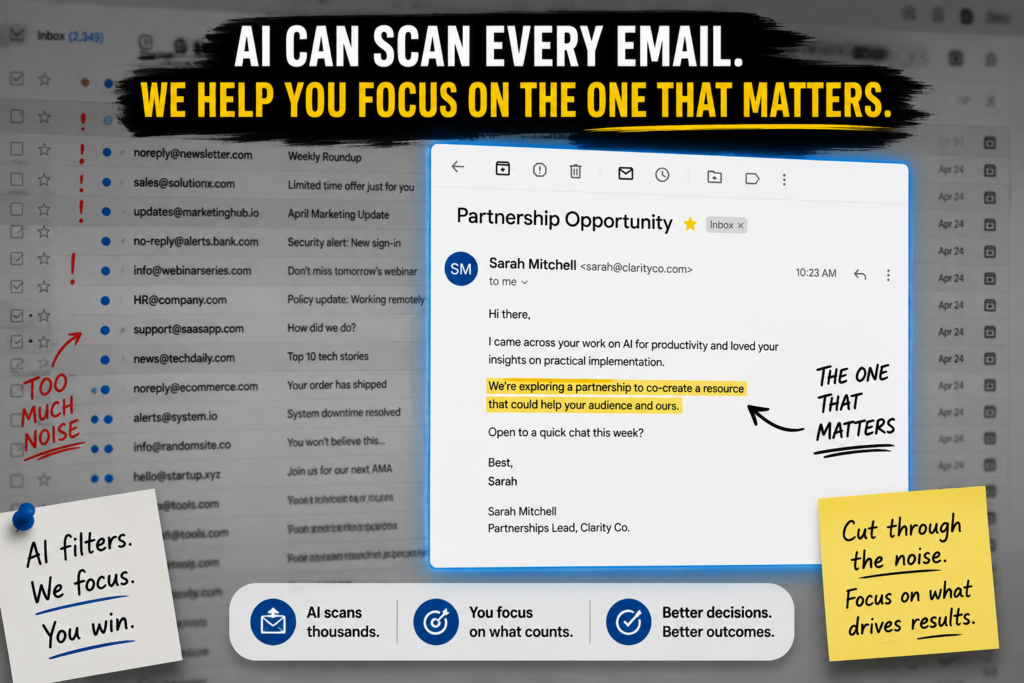
In practice, the opposite has often occurred. Inboxes are now further clogged with emails that are technically well-written but unmistakably generic — the grammatical polish of AI paired with the persuasive substance of a form letter. The problem, communication researchers and growth marketers increasingly agree, is not the tool but the instructions given to it. A poorly prompted AI produces a poorly targeted email, however fluent its sentences.
Why generic prompts produce generic emails
The starting point for most people using ChatGPT for cold outreach is a prompt along the lines of “write a cold email to a marketing manager pitching my services.” The result reads smoothly, uses professional vocabulary, and says almost nothing that could not apply to a hundred other recipients.
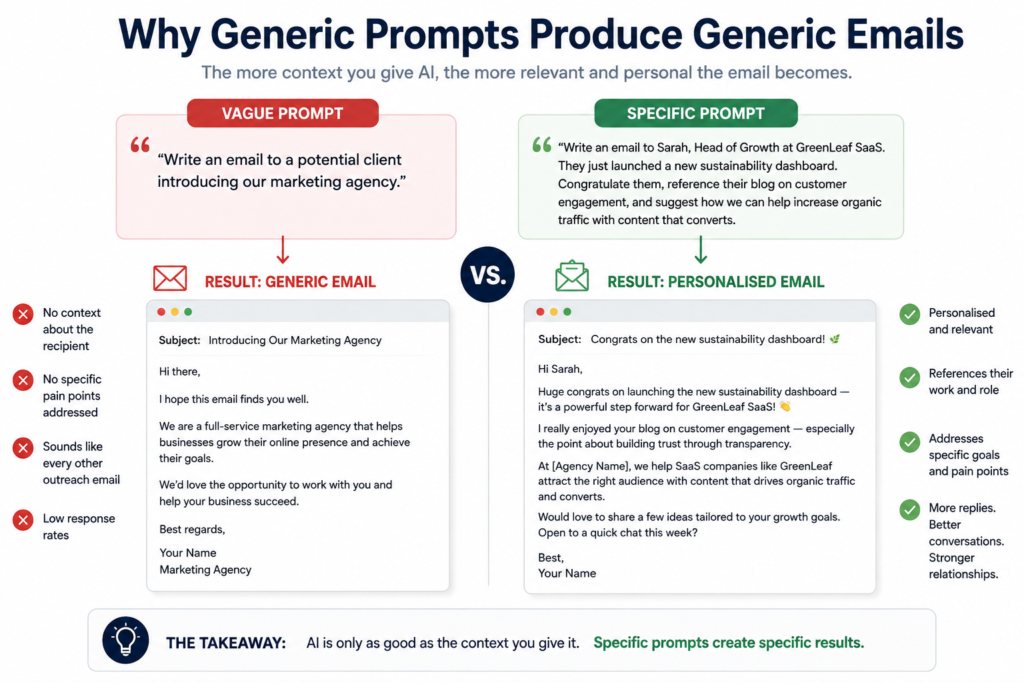
This is not a flaw in the model so much as a direct consequence of the input: a vague prompt forces the AI to fall back on the most statistically common patterns in its training data — the same handful of opening lines, the same structure of problem-solution-call-to-action, the same closing flourish — because it has been given nothing specific enough to deviate from. Recipients, particularly professionals who receive dozens of such emails weekly, recognise this pattern almost instinctively, often within the first sentence.
The fix begins with treating the prompt itself as a brief, not a request. A brief specifies who the recipient is, what evidence exists that they might care about the message, what outcome is being asked for, and what tone would actually suit that particular relationship. The more of this context supplied upfront, the less room the model has to default to boilerplate.
Building the prompt: specificity as strategy
The single most effective addition to a cold email prompt is a piece of concrete, verifiable context about the recipient — a recent product launch, a specific pain point visible in their public work, a mutual connection, or a detail from their company’s recent activity. Instructing ChatGPT to open with “Congratulations on [specific recent milestone]” rather than “I hope this email finds you well” does more than personalise the tone; it signals, correctly, that the sender did their homework, which is itself a persuasive signal independent of what follows.
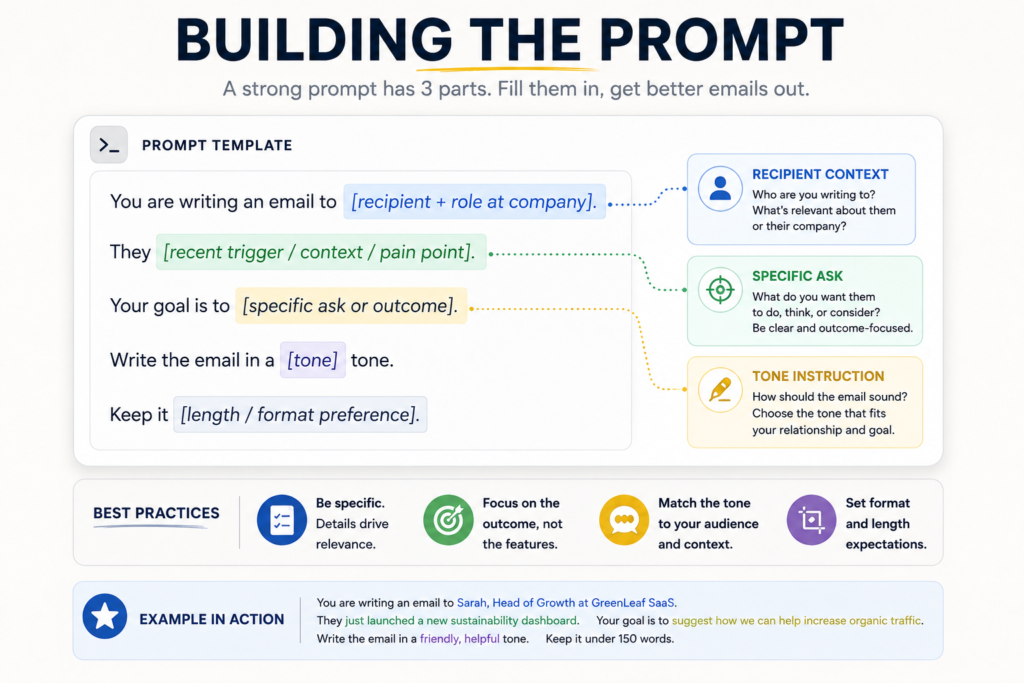
Equally important is specifying the ask with precision. Prompts that request “a short cold email about my consulting services” invite vague output; prompts that specify a single, low-friction next step — “ask only for a 15-minute call next Tuesday or Wednesday, not a meeting request with no timeframe” — tend to produce emails that read as more confident and less like a generic pitch. Growth marketers who study reply-rate data consistently point to this pattern: emails asking for one small, easy, time-bound action outperform ones asking for something open-ended or effortful.
Tone deserves equally deliberate instruction. Left unguided, ChatGPT tends toward a register that is polite but slightly stilted — grammatically correct in a way that reads as impersonal. Prompts that specify a tone reference (“write as though this were a quick note to a colleague, not a formal business letter — contractions are fine, keep sentences short”) consistently produce output that reads as more human, largely because natural human writing is less uniformly polished than the model’s default output.
Length, structure and the discipline of cutting
Cold emails that succeed tend to be short — long enough to establish relevance, short enough to be read on a phone screen in under thirty seconds. This is worth stating explicitly in the prompt itself, since ChatGPT’s default instinct, particularly when asked to “pitch” something, is to elaborate: additional paragraphs justifying the offer, a list of features, a closing paragraph that restates the opening. Instructing the model directly — “keep this under 100 words, three short paragraphs maximum, no bullet points, no restating what was already said” — forces a discipline that most first-draft AI output lacks.
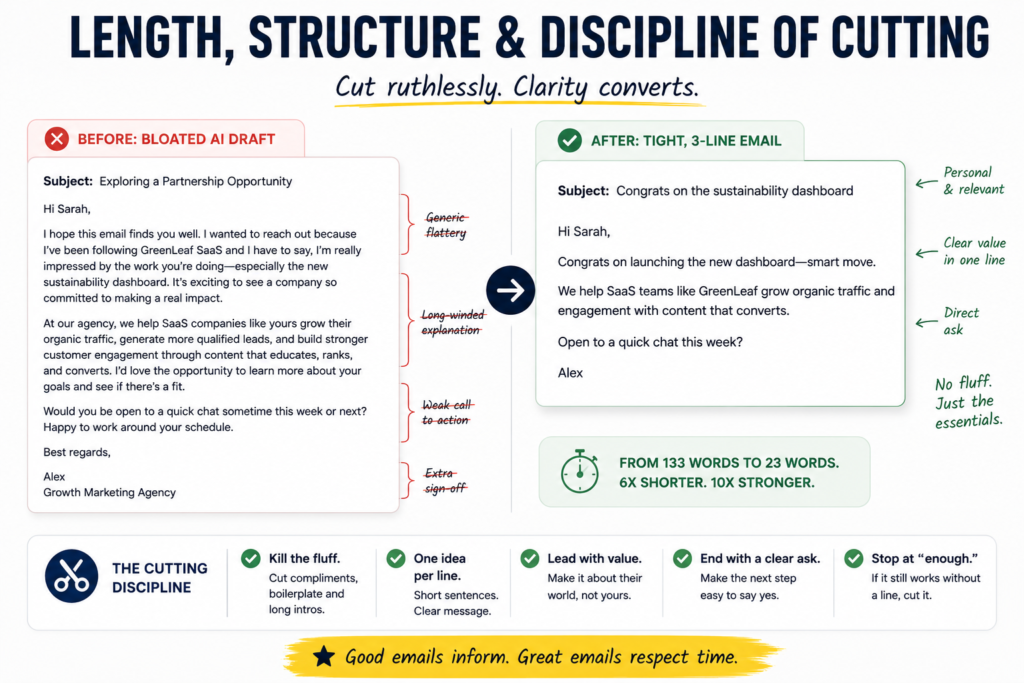
A structure worth specifying explicitly in the prompt: one line establishing relevance or context, one or two lines identifying a specific problem or opportunity, and one line making the ask. Anything beyond this tends to dilute rather than strengthen the message. Some practitioners also prompt for multiple subject line options rather than accepting the model’s first suggestion, since subject lines — often generated as an afterthought — disproportionately determine whether an email is opened at all. A useful instruction here is to ask for subject lines that read as though written by a person, not a marketer: short, lower-case where natural, specific rather than promotional.
The human edit remains non-negotiable
However well-constructed the prompt, cold emails produced by ChatGPT still benefit from a final human pass before sending — not primarily to fix errors, since modern models rarely make grammatical mistakes, but to remove the residual traces of AI phrasing that experienced readers now recognise on sight: overused transitional phrases, unnecessarily formal constructions, and a certain evenness of rhythm that human writing rarely has. Replacing even a handful of these phrases with something rougher or more idiomatic often does more for reply rates than any further refinement of the prompt itself.

It is also worth treating each generated email as a draft to be tested rather than a finished product to be trusted. Practitioners who track outreach performance recommend running small batches with variations — different opening lines, different asks, different subject lines — and using actual reply data to refine future prompts, rather than assuming any single prompt formula will perform consistently across industries, seniority levels or regions.
Precision over polish
What emerges from close study of successful AI-assisted cold outreach is a consistent theme: the quality of the output tracks the specificity of the input far more closely than it tracks the sophistication of the model being used. A detailed, well-structured prompt built around genuine research into the recipient will consistently outperform a vague prompt run through the most advanced model available. Cold email, in this sense, has not been changed in its fundamentals by AI — it has simply relocated the effort. Where once the labour lay in writing each email by hand, it now lies in the research and instruction that goes into the prompt. The tool has become faster; the underlying discipline it rewards has not changed at all.
Thank you for reading.