
If you’ve searched some version of “which AI should I use,” you’ve probably already found a page with a dense table of benchmark percentages — coding scores, math scores, reasoning scores — that looks authoritative right up until you notice the next article you open has different numbers for the same models. That’s not really anyone lying; it’s that these models update constantly, benchmarks get gamed and re-run, and a percentage point difference on a coding test tells a general user approximately nothing about whether a tool will help them write a better cover letter.
A more useful question for most people isn’t “which model wins on paper” — it’s “which one fits what I’m actually trying to do this week.” That’s what this guide answers, based on what each of these four tools has consistently, durably been good at, rather than whichever benchmark happened to lead this month.
Quick Answer: What to Use for What
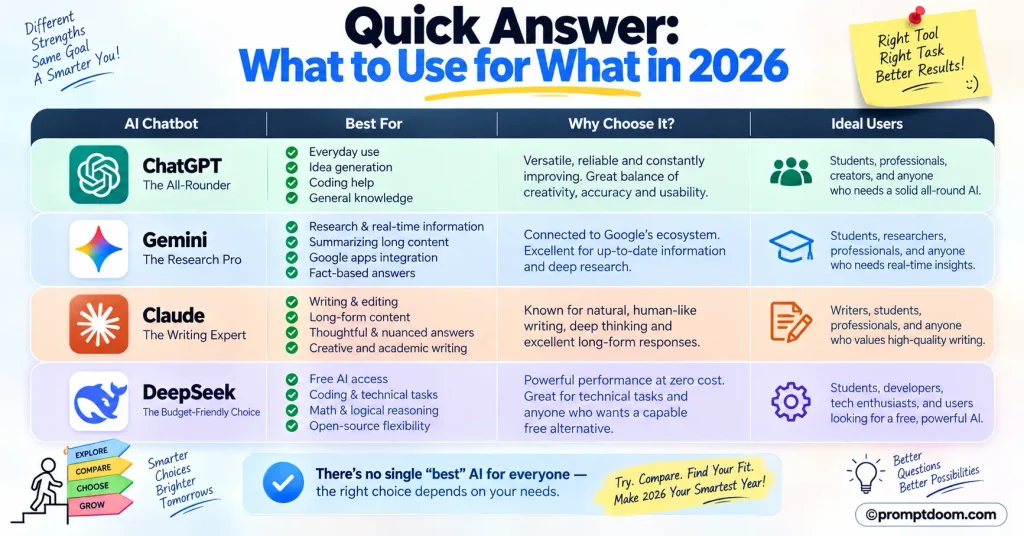
- General everyday use, broadest range of features: ChatGPT
- Long writing, careful editing, working through a big document: Claude
- You’re already in Google Docs, Gmail, or Android, or want a big free allowance: Gemini
- You want a capable free tool and don’t mind a less polished app: DeepSeek
If none of those map cleanly onto what you need, the breakdown below goes deeper into what each one is actually like to use day to day.
ChatGPT: The Broadest All-Rounder
ChatGPT remains the most recognizable and generally the most versatile of the four for a simple reason — it was first to reach mainstream adoption, and OpenAI has built out the widest range of features and integrations around it as a result: image generation, voice conversation, custom GPTs for specific tasks, and broad third-party plugin support. For a general user who wants one tool that handles writing, research, brainstorming, coding help, and image generation reasonably well without switching apps, ChatGPT is the safest default.
The tradeoff is that “does everything reasonably well” sometimes means it’s not the sharpest tool for any one specific task compared to a competitor that specializes. It’s rarely the wrong choice, but it’s not always the best one for something like a long, careful piece of writing or deep document analysis.
Claude: Best for Writing Quality and Long Documents
Claude has built a consistent reputation, across many independent reviews and user reports, for producing writing that reads as more natural and less generic than its competitors, along with a genuine strength in handling long documents and sustained, careful reasoning through a complex piece of writing or analysis. If your main use case is drafting something that actually needs to sound like a person wrote it — an essay, an article, a detailed email — or you need to paste in a long document and have it reasoned through carefully, Claude is frequently the preferred choice among people who’ve tried multiple tools side by side for exactly this purpose.
The tradeoff is a narrower feature set outside of writing and reasoning — image generation and some of the broader ecosystem integrations available elsewhere are more limited.
Gemini: Best for Google Integration and a Generous Free Tier
Gemini’s biggest practical advantage for a general user is how deeply it sits inside tools most people already use — Google Docs, Gmail, Google Sheets, and Android phones — which means it can act directly on your actual files and inbox rather than requiring you to copy and paste content back and forth. It’s also consistently noted for offering one of the more generous free usage tiers among the major tools, and for strong performance on tasks involving images, video, or very long reference documents at once.
The tradeoff is that some users find its personality and writing style slightly less polished for pure creative or long-form writing compared to Claude or ChatGPT, though this gap has narrowed with newer versions.
DeepSeek: Best for Cost-Conscious and Open-Weight Users
DeepSeek’s core appeal for a general user is straightforward: it’s free to use through its chat interface, and its underlying models are released as open weights, meaning developers and more technical users can run or fine-tune it themselves rather than relying entirely on a company’s hosted service. For everyday tasks like writing, research, coding help, and math, it performs competitively with the other three, at a noticeably lower cost if you’re using it through an API for a larger volume of tasks.
The tradeoff for a general user is a less polished consumer app experience compared to ChatGPT or Gemini, and — since DeepSeek is a Chinese company — it’s worth being thoughtful about what kind of information you share with it, particularly anything sensitive or confidential, the same caution worth applying to any AI tool whose data handling policies you haven’t reviewed.
What About Cost?
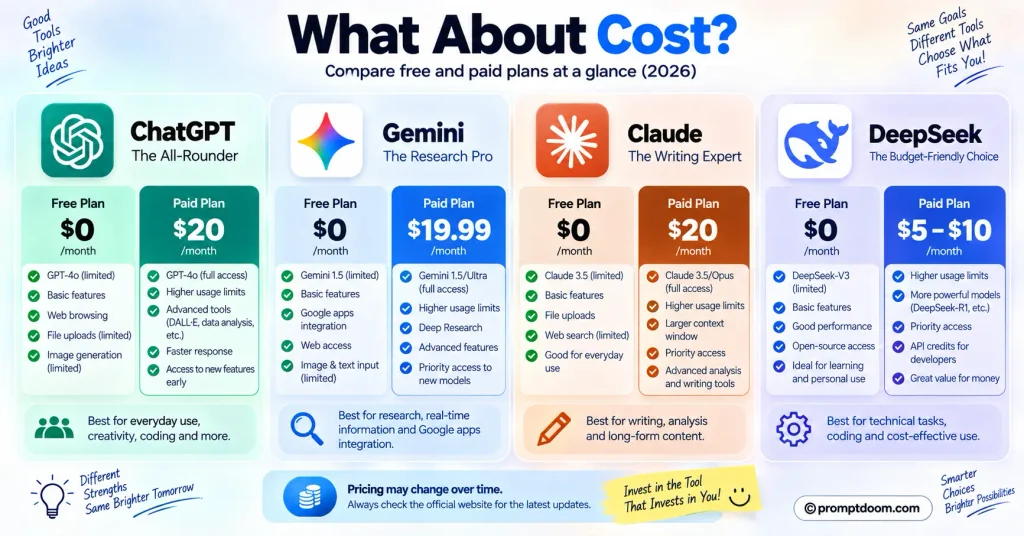
All four offer a usable free tier, which is where most general users should start regardless of which one they eventually settle on. ChatGPT, Gemini, and Claude each offer a paid tier, typically in a similar monthly price range, that raises usage limits and unlocks access to their more capable models — genuinely worth it if you use the tool daily for substantial tasks, and unnecessary if you’re checking in a few times a week for quick questions. DeepSeek’s consumer chat interface remains free without a comparable paid consumer tier, with its cost advantage showing up mainly for developers using its API rather than everyday chat users.
You Don’t Actually Have to Pick Just One
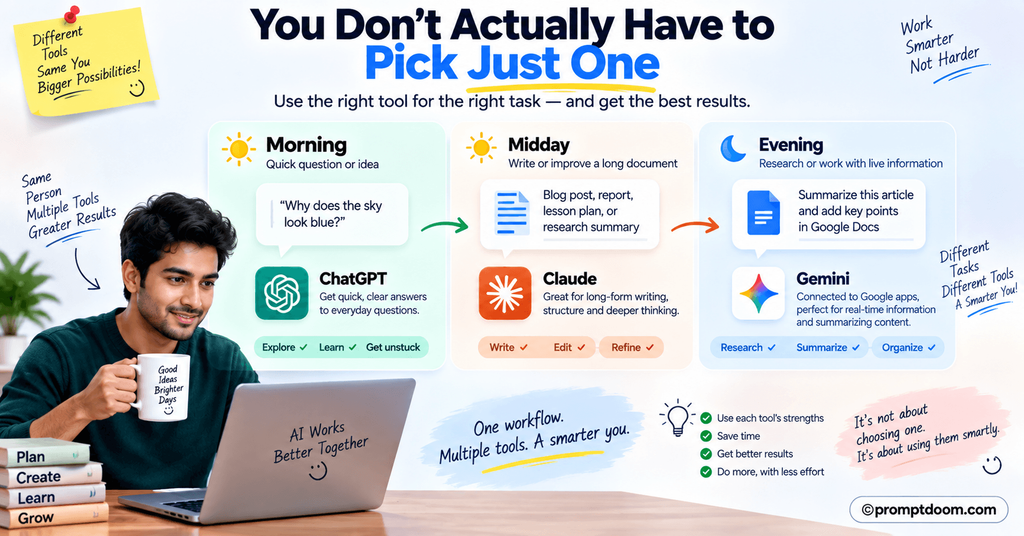
A pattern that’s become increasingly common, especially among people who use AI tools for work, is simply using more than one — ChatGPT or ChatGPT’s app for everyday quick tasks, Claude for a long piece of writing that needs to read well, and Gemini when working directly inside a Google Doc or Gmail. Since three of the four have workable free tiers, there’s very little cost to trying each one on a task it’s supposed to be good at and noticing which result you actually prefer, rather than committing to one tool based on an article’s recommendation alone.
What the Evidence Suggests
Across dozens of comparisons reviewed for this article, one thing holds steady even as specific version numbers and benchmark scores shift monthly: there is no single best AI tool for every task, and the tools that consistently show up as “winners” in any given comparison tend to be the ones whose specific strength matches whatever the reviewer happened to be testing. For a general user, the more durable and useful takeaway is matching the tool to the task — ChatGPT for breadth, Claude for writing and long documents, Gemini for Google-native workflows and a generous free tier, DeepSeek for cost-consciousness — rather than searching for a single universal winner that, by most accounts, doesn’t really exist.
Frequently Asked Questions
Still deciding which AI chatbot is right for you? Here are answers to the questions beginners ask most.
ChatGPT is generally the easiest starting point, since it has the broadest range of built-in features and the most widely available tutorials and community support if you get stuck.
Many users who’ve compared both directly find Claude’s writing reads more naturally and less generically, particularly for longer pieces, though ChatGPT remains a strong and more feature-rich general-purpose option.
No — all four offer a usable free tier. Paid plans mainly raise usage limits and unlock more capable model versions, which matters most for people using a tool daily for substantial tasks.
For everyday, non-sensitive tasks like writing and research, most users find it fine to use. For confidential business data or sensitive personal information, it’s worth reviewing DeepSeek’s current privacy policy before sharing, the same caution worth applying to any AI provider.
Yes, and it’s an increasingly common approach — many people use ChatGPT for quick everyday tasks, Claude for longer writing, and Gemini when working directly inside Google Docs or Gmail, switching based on the task rather than committing to one tool exclusively.
It depends on the task: Gemini integrates directly with Google Docs, which many students already use for assignments; Claude tends to handle long reading and writing assignments well; and ChatGPT offers the broadest general-purpose help across subjects.