
ChatGPT Prompts for Rewriting Awkward Sentences: Every writer has produced a sentence that technically obeys every grammar rule and still sounds wrong. The subject and verb agree, the punctuation is correct, and yet a reader stumbles over it, rereads it, and can’t immediately say why. That gap between “grammatically correct” and “reads naturally” is where most everyday editing time gets spent, and it’s exactly the kind of problem ChatGPT is well suited to help with, provided the prompt tells it what specifically to fix rather than just asking it to “make this better.”
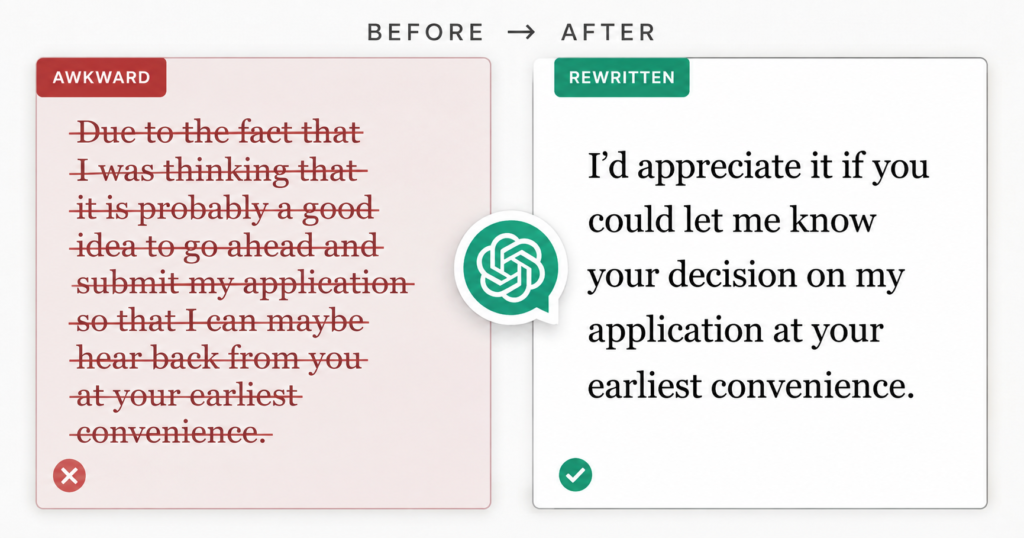
The difference between a prompt that works and one that produces bland, generic output almost always comes down to specificity. A vague instruction like “rewrite this sentence” gives ChatGPT no signal about what kind of awkwardness it’s dealing with wordiness, a buried subject, an unnatural translation pattern, or a tone mismatch each need a different fix. The prompts below are grouped by cause, not just by outcome, so you can match your sentence to the right one instead of guessing.
Why Sentences Feel Awkward in the First Place
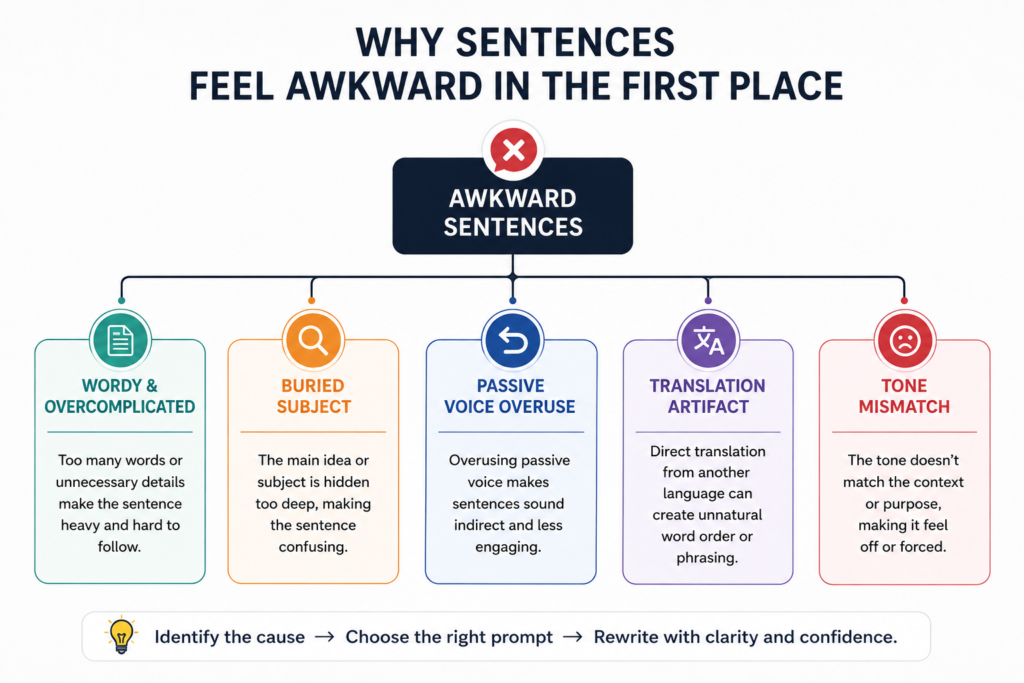
Before reaching for a prompt, it helps to know what you’re actually diagnosing. Most awkward sentences fall into a small number of recognisable categories: they bury the main subject under too many clauses, they use more words than the idea requires, they lean on passive voice when an active subject would be clearer, they carry sentence patterns translated too literally from another language, or they mix formal and informal register in a way that reads as inconsistent. Naming the problem first makes the prompt far more effective, because it lets you ask ChatGPT to target that specific issue instead of performing a generic pass.
Prompts for Fixing Wordy, Overloaded Sentences
Prompt: “Rewrite this sentence to say the same thing in the fewest possible words, without losing any meaning: [sentence]”
Before: “Due to the fact that the meeting had already started by the time we arrived, we made the decision to wait outside until it had come to an end.”
After: “Since the meeting had already started, we waited outside until it ended.”
The rewrite cuts the sentence roughly in half by removing redundant framing phrases (“due to the fact that,” “we made the decision to”) that add length without adding information. This is the single most common category of awkwardness in first-draft writing, particularly in professional emails and reports.
Prompts for Sentences With a Buried Subject
Prompt: “Rewrite this sentence so the main subject and action are clear near the beginning: [sentence]”
Before: “It was decided, after extensive discussion among the stakeholders involved in the project, that the deadline would need to be extended.”
After: “After extensive discussion, the stakeholders decided to extend the deadline.”
Here the fix isn’t about word count, it’s about restoring an actor to the sentence. The original hides who decided behind the passive construction “it was decided,” which forces the reader to hold the sentence in memory until the true subject finally appears.
Prompts for Passive Voice Overuse
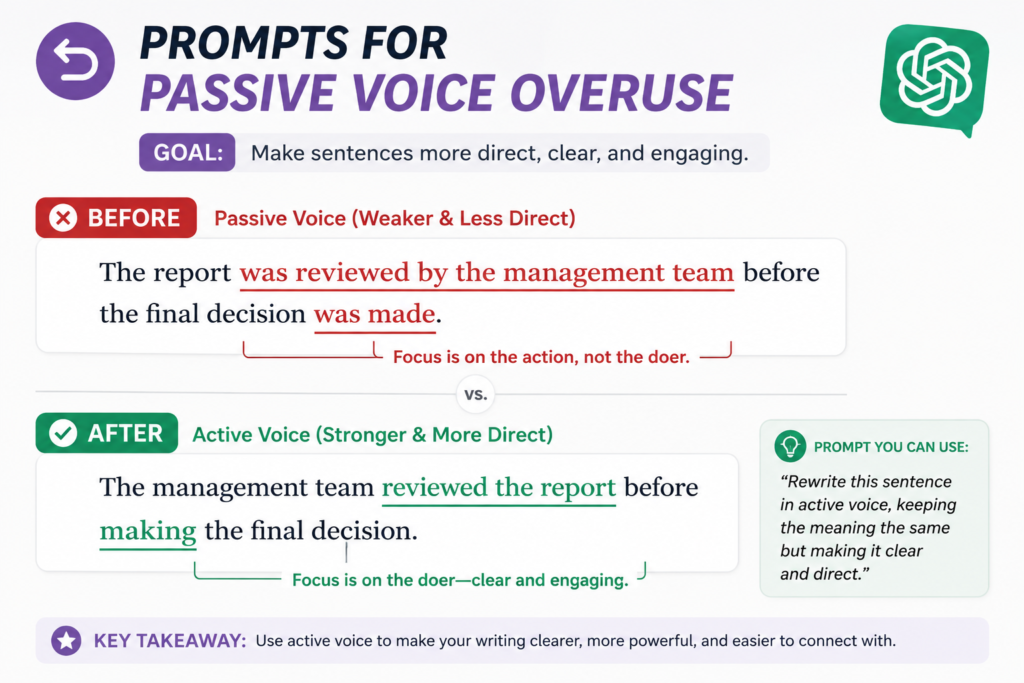
Prompt: “Rewrite this sentence in active voice, keeping the same meaning: [sentence]”
Before: “The report was reviewed by the committee and several errors were found in the data.”
After: “The committee reviewed the report and found several errors in the data.”
Passive voice isn’t grammatically wrong, and it has legitimate uses, for example, when the actor is unknown or irrelevant. But when it’s used by default, sentences lose their sense of momentum. Asking ChatGPT specifically for “active voice” rather than “make this better” produces a far more reliable fix than a general rewrite request.
Prompts for Sentences That Read Like a Literal Translation
Prompt: “Rewrite this sentence so it sounds like something a native English speaker would naturally say, without changing the meaning: [sentence]”
Before: “I am having many years of experience in this field and I am doing this work since long time.”
After: “I have many years of experience in this field and have been doing this work for a long time.”
This category is especially common among non-native English writers, where sentence patterns from another language get carried over, continuous tense used where simple past or present perfect is more natural, or missing articles. The key instruction here is “sounds like something a native speaker would say,” which pushes ChatGPT toward idiomatic phrasing rather than a literal grammar correction.
- How to Write a Marketing Persona Prompt for ChatGPT (With Template)
- 10 ChatGPT Prompts for Writing Blog Post Outlines Fast (With a Real Example)
Prompts for Fixing Tone Mismatch
Prompt: “Rewrite this sentence to sound consistently professional throughout, right now part of it sounds formal and part sounds casual: [sentence]”
Before: “We regret to inform you that your request has been denied, so yeah, that’s not gonna work for us.”
After: “We regret to inform you that your request has been denied and are unable to accommodate it at this time.”
Tone inconsistency is one of the harder problems to self-diagnose, because each half of the sentence reads fine on its own. Pointing ChatGPT specifically at the inconsistency, rather than asking it to “make this more formal,” preserves the parts of the sentence that were already working.
Prompts for Long, Run-On Sentences
Prompt: “Split this sentence into two or three shorter sentences if that improves clarity, without losing any information: [sentence]”
Before: “The company launched the product in March, and initial sales were strong, but by June demand had slowed considerably, which led the leadership team to revisit the marketing strategy and consider a price adjustment.”
After: “The company launched the product in March, and initial sales were strong. By June, however, demand had slowed considerably. This led the leadership team to revisit the marketing strategy and consider a price adjustment.”
Long sentences aren’t inherently awkward, but when they stack three or four independent ideas with commas alone, readers lose track of which idea is subordinate to which. Explicitly permitting ChatGPT to split the sentence, rather than just “fix” it, produces a cleaner result than compression alone would.
What This Means for Everyday Writing
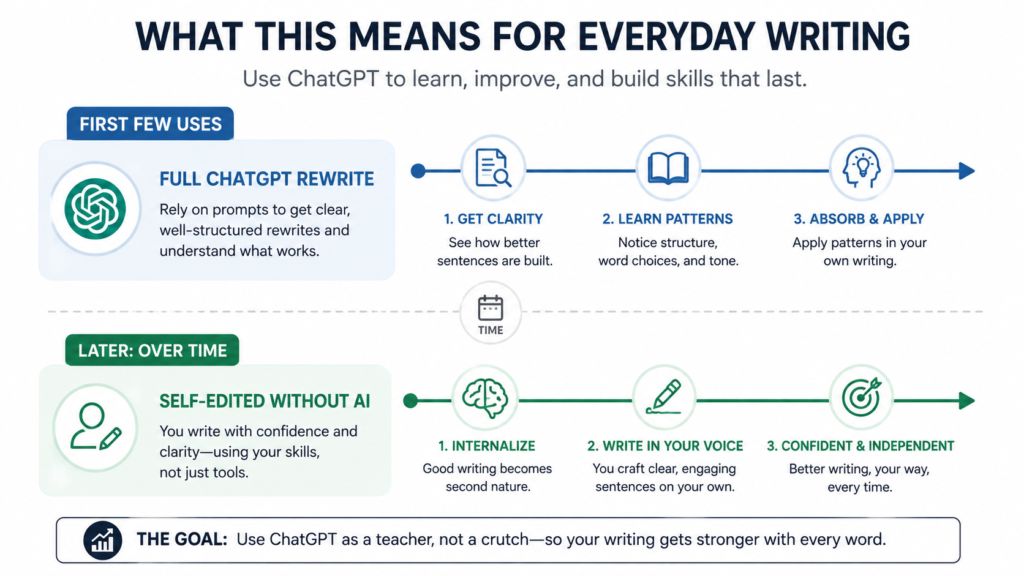
The practical value of these prompts isn’t limited to one-off fixes. Used consistently, they function as a form of self-editing training: after seeing enough before/after pairs in a given category, most writers start noticing the pattern in their own first drafts before ChatGPT even sees them. That’s a meaningfully different outcome from simply outsourcing every sentence to an AI tool, it shortens the distance between draft and final copy over time, rather than creating permanent dependence on the tool.
It’s also worth being deliberate about when not to use these prompts. Rewriting for clarity is different from rewriting for voice, and running every sentence through a “make this sound natural” prompt can quietly erase a writer’s distinctive style along with the awkwardness. The prompts above work best applied selectively, to sentences that have already been flagged by a reader, an editor, or your own second read-through rather than as a blanket pass over an entire draft.
What the Evidence Suggests
Prompt specificity is the consistent variable that separates a useful rewrite from a generic one. Broad instructions such as “improve this” or “make it better” tend to produce safe, flattened prose that reads correctly but loses the original’s specific character. Prompts that name the exact failure mode wordiness, passive voice, buried subject, tone mismatch, translation artifact, run-on structure give the model a clear editing target and, in practice, produce rewrites that are both more accurate to the original intent and easier to evaluate against a known standard.
FAQ Section
Is it better to ask ChatGPT to “fix” a sentence or to give it a specific instruction?
A specific instruction almost always produces a better result. “Fix this sentence” gives ChatGPT no target, so it tends to make small, generic changes. Naming the actual problem wordiness, passive voice, tone, run-on structure produces a rewrite that addresses the real issue rather than a surface-level pass.
Can ChatGPT rewrite a sentence without changing its meaning?
Yes, if the prompt explicitly asks for it. Including a phrase like “without losing any meaning” or “keeping the same meaning” in the prompt significantly reduces the risk of ChatGPT quietly dropping or altering details during the rewrite.
Will using these prompts make my writing sound like AI?
Not if you use them selectively on flagged sentences rather than running an entire draft through ChatGPT. Applying a rewrite prompt to every sentence tends to flatten a writer’s natural voice; using it only on sentences that already read awkwardly preserves the rest of your original style.
Are these prompts useful for non-native English speakers specifically?
Yes, the “sounds like a native speaker” prompt category is particularly effective for translation-pattern awkwardness, such as unnatural tense use or missing articles, which standard grammar checkers often miss because the sentence is technically grammatical.
Do I need ChatGPT Plus to use these prompts, or does the free version work?
The free version of ChatGPT can run all of the prompts in this article; none of them require a paid plan. Paid tiers offer benefits like higher usage limits and access to more capable models, but they aren’t necessary for basic sentence-level rewriting.
How long should a rewrite prompt be?
Long enough to name the specific problem and any constraint (tone, meaning, length), but not so long that it buries the actual instruction. A one- or two-sentence prompt with a clear target, as shown in each example above is typically more effective than a lengthy, multi-paragraph instruction.
Can I use the same prompt for an entire paragraph instead of one sentence?
Yes, most of these prompts scale to paragraph length with minor adjustment, for example, replacing “sentence” with “paragraph” in the instruction. Longer inputs may need more specific guidance, since a paragraph is more likely to contain more than one type of awkwardness at once.