
A marketing persona is only useful if it changes a decision — which channel to advertise on, which pain point to lead an email with, which feature to highlight on a landing page. Most personas built with a generic ChatGPT prompt fail at exactly that step. They read well as a document, listing an age range, a job title, and a handful of generic goals, but they don’t contain anything specific enough to actually shape a campaign. The problem isn’t ChatGPT’s ability to write a persona — it’s that most prompts ask for the wrong inputs.
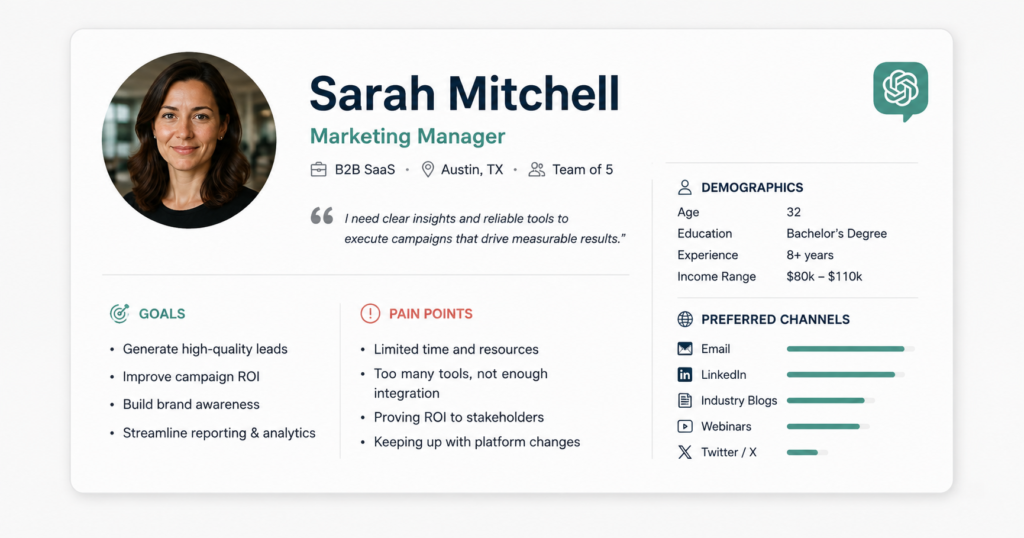
The fix starts with recognising that a buyer persona isn’t one universal format. What determines a consumer’s purchase decision is often different in kind from what determines a business buyer’s decision, and a prompt that treats both the same way produces a persona that’s technically complete but practically useless for at least one of them.
Why Generic Persona Prompts Produce Unusable Output
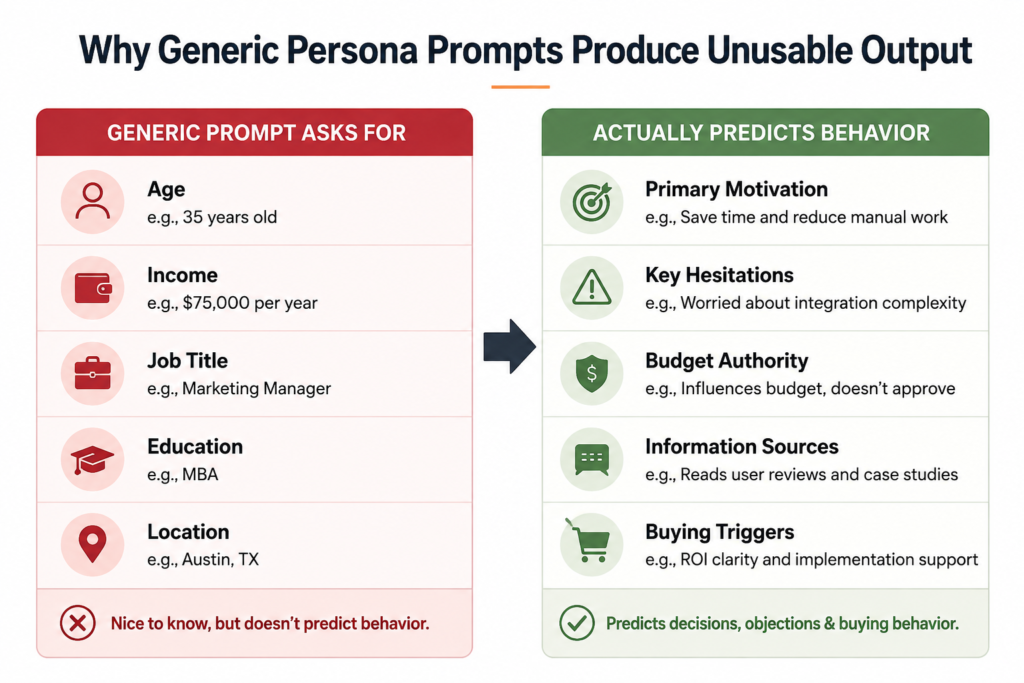
Ask ChatGPT to “create a buyer persona for my product” with no further detail, and it will default to a template built around age, gender, occupation, income, and a vague set of goals and frustrations — information that sounds like market research but rarely maps onto an actual marketing decision. A 34-year-old marketing manager and a 51-year-old marketing manager might make near-identical B2B purchasing decisions if their budget authority and internal approval process are similar; the age gap tells you almost nothing useful, but it’s exactly the kind of detail a generic prompt asks for first.
The fix is to prompt for what actually predicts behaviour in your specific market — which is different for consumer products than for business purchases.
The B2C Persona Prompt Template
Prompt: “Create a marketing persona for [product/service], targeting [general audience description]. Include: their core motivation for wanting this type of product, the specific problem or unmet need that drives them to search for a solution, what they’ve likely tried before that didn’t fully work, their biggest hesitation before purchasing, where they spend time online, and what kind of messaging tone would resonate with them (e.g., practical, aspirational, humorous). Give the persona a name and a one-sentence summary at the top. Keep demographic details brief — one line, not a full profile.”
This version deliberately limits demographic detail to a single line rather than letting it dominate the output, and instead front-loads the motivation, hesitation, and prior-attempts information that actually shapes ad copy and landing page messaging.
The B2B Persona Prompt Template
Prompt: “Create a B2B buyer persona for [product/service], targeting [job title/role] at [company size/industry]. Include: their role in the purchasing decision (final approver, influencer, or researcher), the business problem this solves for their team, what they need to justify the purchase internally, who else is likely involved in the approval process, their biggest objection or risk concern, and which content format they’re most likely to engage with (case study, demo, whitepaper, etc.). Skip age, gender, and personal demographic details entirely — focus only on role and organisational context.”
The explicit instruction to skip personal demographics is deliberate. In B2B contexts, a buyer’s purchasing behaviour is shaped far more by their role, budget authority, and internal politics than by any personal characteristic, and removing that clutter from the prompt keeps the output focused on details a sales or marketing team can actually act on.
A Worked Example: B2C Persona in Practice
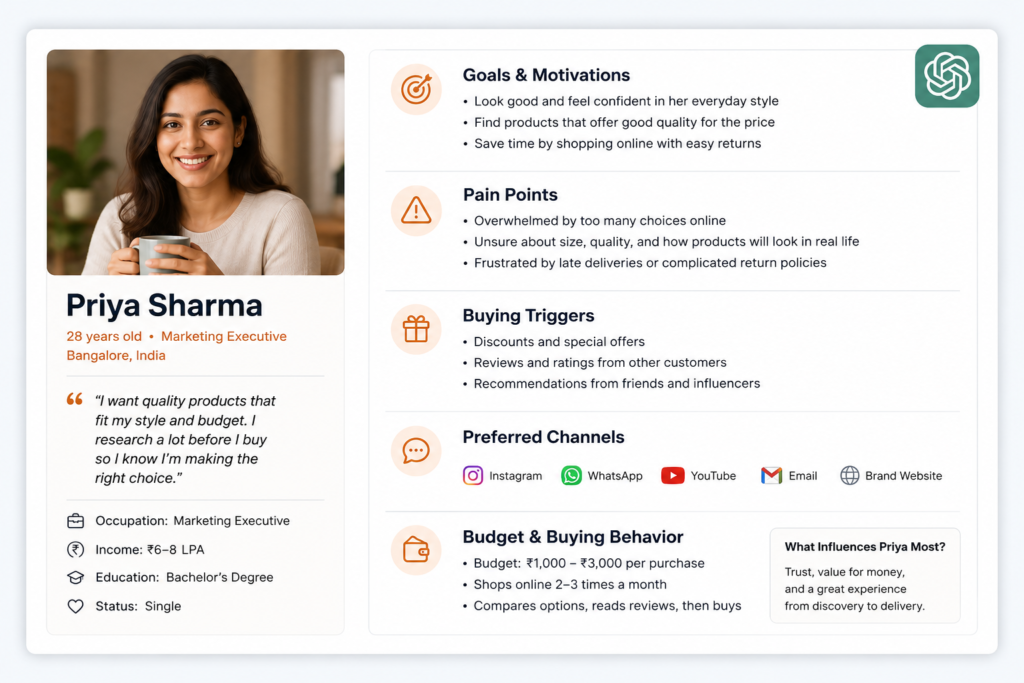
Inputs used: Product: a subscription meal-kit service for busy professionals. Audience: working adults aged roughly 28–45 who want to eat healthier but don’t have time to plan meals.
Resulting persona:
Priya, the Time-Strapped Improver — Works full-time, wants to eat healthier but has tried and abandoned three different diet apps because they required too much manual tracking.
- Core motivation: Wants the feeling of eating well without the mental overhead of planning it
- Unmet need: Grocery shopping and meal planning feel like a second job on top of an already full one
- What she’s tried before: Meal-prep Sundays that fell apart by week three; a calorie-tracking app she deleted after two weeks
- Biggest hesitation before purchasing: Worried the food will taste like “diet food” or that portions will be too small to actually feel full
- Where she spends time online: Instagram and short-form video, particularly recipe and productivity content
- Messaging tone that resonates: Practical and reassuring rather than aspirational — she responds better to “this actually saves you time” than to idealised lifestyle imagery
Notice what’s absent: there’s no invented income bracket, no fabricated relationship status, no filler detail that doesn’t inform a marketing decision. Every line either shapes what the ad copy should say or what channel it should run on.
Common Mistakes That Make a Persona Useless
Treating demographics as the main event. Age and income can matter, but only when they genuinely correlate with the buying behaviour in question. If they don’t change what messaging you’d use, they don’t need to anchor the persona.
Making the persona too broad to represent anyone specific. A persona meant to represent “most of our customers” usually ends up representing none of them precisely. It’s more useful to build two or three sharper personas for your top segments than one blurry composite.
Skipping the objection or hesitation field. A persona without a stated purchase hesitation gives a marketing team nothing to write copy against. The hesitation is often the single most actionable field in the whole document.
Generating it once and never updating it. Buyer behaviour shifts — pricing sensitivity, competitor landscape, and channel habits all change over time. A persona built a year ago and never revisited can quietly steer campaigns in the wrong direction.
What to Actually Do With a Finished Persona
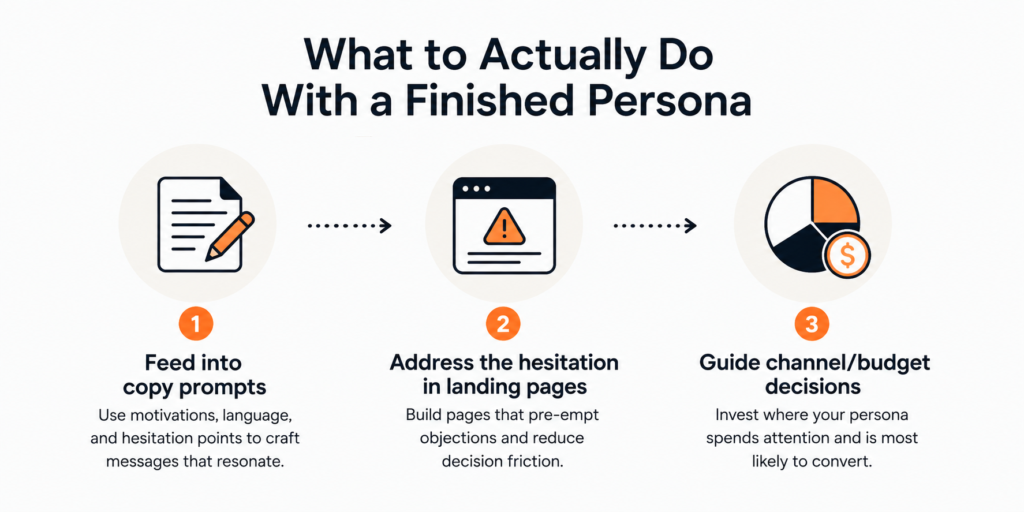
A persona sitting in a shared drive changes nothing on its own. Once you have one, use it in three concrete ways: paste it into future ChatGPT prompts when drafting ad copy or email subject lines so the tone stays consistent with what the persona would respond to, use the stated hesitation field as the specific objection your landing page copy needs to address, and reference the preferred channel and content format fields when planning where campaign budget actually goes. Treating the persona as a working input to other prompts, rather than a standalone document, is what turns it from a nice-to-have artifact into something that measurably shapes a campaign.
What the Evidence Suggests
Across marketing guidance on this topic, one distinction stands out clearly: personas built around behavioural drivers — motivation, hesitation, decision authority — consistently prove more useful for campaign decisions than personas built primarily around demographic description. This holds particularly strongly in B2B contexts, where role and internal approval dynamics tend to predict purchasing behaviour far more reliably than any personal characteristic. The practical implication for prompting ChatGPT is straightforward: ask for what predicts a decision, not just what describes a person.