
Ask ChatGPT to “create a business plan outline” with nothing else attached, and it will return something close to a textbook table of contents: executive summary, company description, market analysis, organizational structure, marketing plan, financial projections. It’s not wrong, exactly — this is a genuine standard structure — but it’s also identical to what thousands of other founders have already received from the same prompt, and it doesn’t yet reflect the one thing that should actually shape the outline: who’s going to read it.
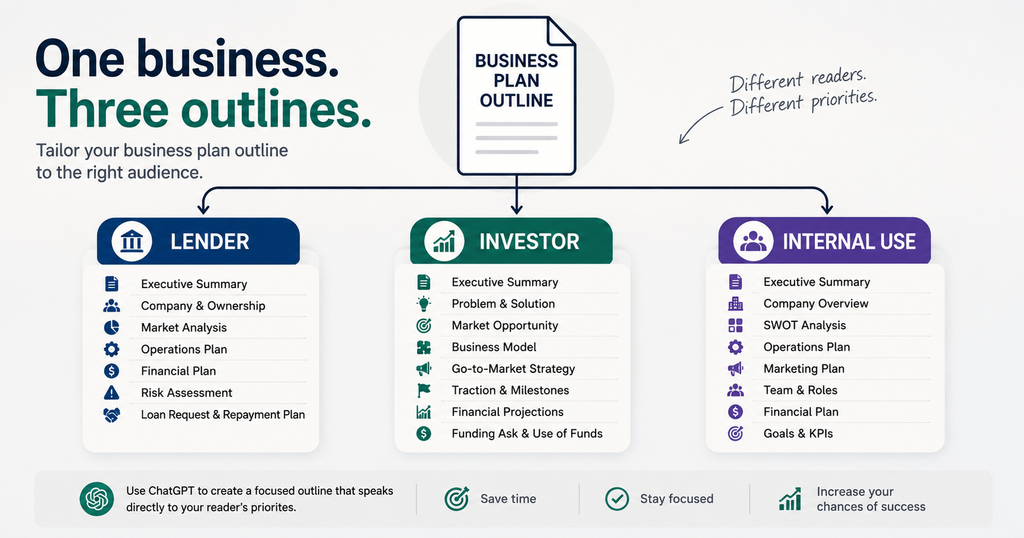
A lender evaluating a loan application is looking for something different than an investor evaluating equity risk, and both are looking for something different than a founder using the plan purely to organize their own priorities. Getting a genuinely useful outline out of ChatGPT means telling it that up front, along with enough business context that the sections it proposes actually fit what you’re building — rather than accepting the generic version and hoping the details work themselves out later.
Step One: Give ChatGPT Business Context Before Asking for Structure
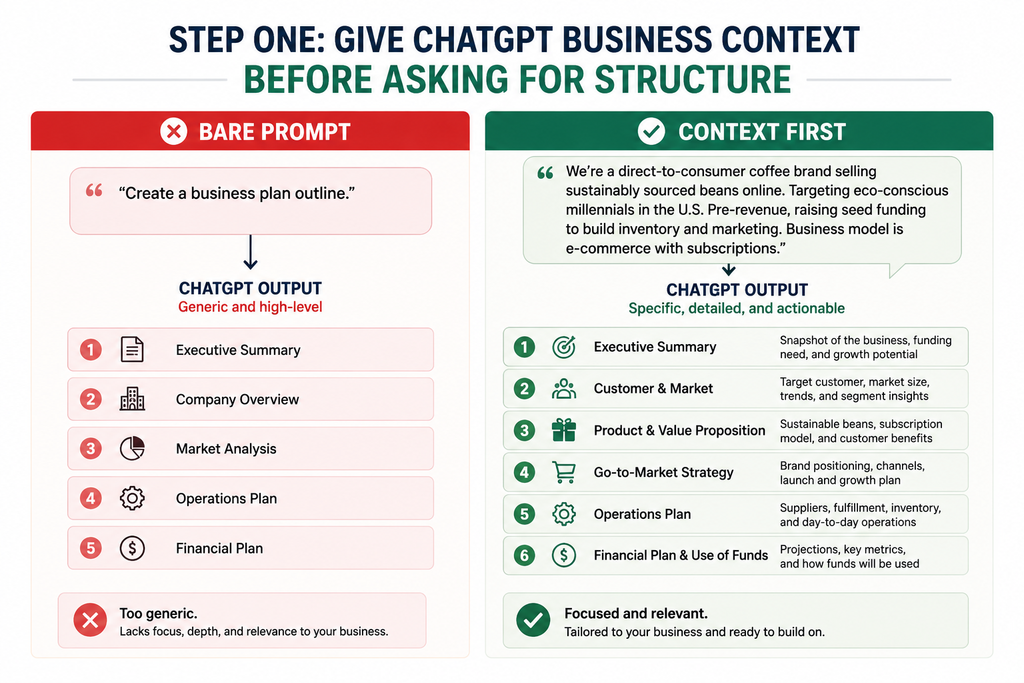
Prompt: “I’m starting a business. Here are the key facts: [business name/concept], [what you sell or offer], [target customer], [location/market], [rough stage — idea, pre-launch, or already operating], [how you’ll make money]. Don’t write anything yet — just confirm you understand the business, and ask me any questions you’d need answered before creating a business plan outline for it.”
This step matters more than it looks. Asking ChatGPT to confirm understanding and ask clarifying questions, rather than jumping straight to output, surfaces missing details — like your revenue model or competitive landscape — before they turn into vague, generic sentences buried in a finished outline later. Answer whatever it asks before moving to the next step.
Step Two: Specify Who the Plan Is For
Prompt: “Based on the business context I’ve given you, create a business plan outline for [a bank/SBA loan application / an equity investor / internal planning purposes]. Structure it with the sections and level of emphasis that this specific audience would expect to see, not a generic template. Don’t write full section content yet — outline headings and a one-sentence note on what each section should cover.”
This is the step most generic prompts skip entirely, and it’s the reason the same business can reasonably produce three different-looking outlines depending on the answer.
- For a lender: expect more emphasis on repayment ability, cash flow projections, collateral, and owner investment — the details a bank underwriter is specifically trained to look for.
- For an investor: expect more emphasis on market size and opportunity, growth trajectory, competitive moat, and a clear path to return — the details that matter to someone assessing equity risk, not repayment risk.
- For internal use: expect more emphasis on milestones, resource allocation, and priorities — sections that would be irrelevant padding in a lender or investor version but are exactly what a founder needs to actually run against.
The Standard Section Structure (as a Starting Reference)
Regardless of audience, most legitimate business plan outlines draw from the same pool of sections, with the reader determining which get expanded and which get trimmed:
- Executive summary
- Company description
- Market analysis (industry background, target market, competitor analysis)
- Organization and management structure
- Products or services
- Marketing and sales strategy
- Funding request (if applicable)
- Financial projections
- Appendix
Rather than accepting this list verbatim, use it as a reference point when reviewing what ChatGPT proposes in Step Two — if a section it suggests is missing something from this list that matters for your specific audience, ask for it to be added before moving forward.
A Worked Example: Same Business, Two Audiences
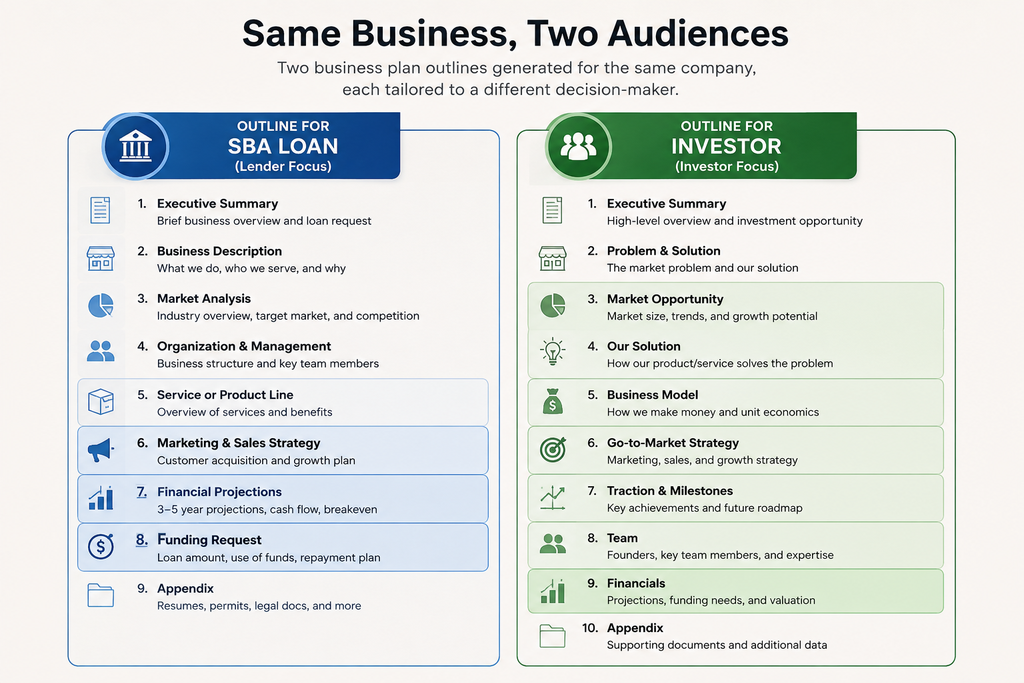
Business context given: FreshFork, a pre-launch meal-prep delivery service in Austin, targeting busy professionals, revenue from weekly subscription boxes.
Outline generated for an SBA loan application led with a section on startup costs and use of loan funds, followed by a detailed cash flow projection and a section specifically addressing repayment ability and collateral — sections a generic outline prompt is unlikely to surface unless the audience is specified.
Outline generated for an equity investor, using identical business context, instead led with market opportunity and total addressable market, followed by a competitive differentiation section and a growth/scaling plan — with financial projections still present, but framed around growth trajectory rather than repayment.
Same business, same underlying facts, meaningfully different outline — because the second prompt in the sequence told ChatGPT who was actually going to read the document.
Common Mistakes When Prompting for a Business Plan Outline
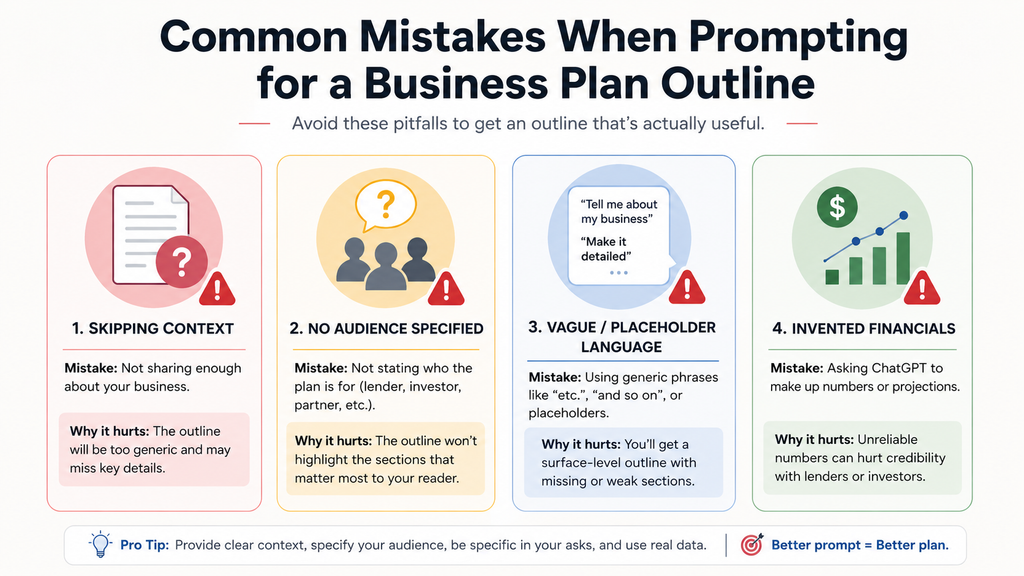
Skipping the context step entirely. Jumping straight to “give me a business plan outline for a coffee shop” produces a generic structure that has no connection to your specific business, location, or stage, and every section will need heavy rewriting later to actually fit.
Not specifying the audience. Without this, ChatGPT defaults to a balanced, one-size-fits-all structure that under-serves whichever reader actually receives it — too light on repayment detail for a lender, too light on market opportunity for an investor.
Accepting vague placeholder language without pushing back. Left unprompted, sections can come back with soft phrasing like “a broad demographic of customers” or “a competitive pricing strategy” that sound plausible but say nothing specific. Ask ChatGPT directly which parts of the outline are still too vague to build a real section from, and fill in that gap yourself rather than letting it stand.
Trusting invented financial figures. If financial details weren’t part of the context you provided, don’t let ChatGPT fill projections in with plausible-sounding numbers. Ask it to mark exactly where a number needs to go, then supply the real figure yourself or work it out with a financial advisor.
What to Do Once the Outline Is Approved
Once the outline reflects your business and your intended audience, work through it section by section rather than asking for the entire plan at once. For each section, feed ChatGPT the specific facts relevant to that section only — for a marketing and sales section, your actual planned channels, budget, and target metrics, not just “help me write the marketing section.” This keeps each section grounded in real information rather than filled with generic, plausible-sounding filler that a lender or investor is likely to challenge in exactly the places it matters most.
What the Evidence Suggests
Across the guidance reviewed for this article, one point stands out consistently: ChatGPT’s business plan output is only as specific as the business context and intended audience it’s given. Left with a bare prompt, it defaults to a standard, generic structure that’s technically correct but under-serves whoever eventually reads it. Given real business details and told explicitly who the plan is for, it produces an outline meaningfully closer to what that specific reader — a lender, an investor, or the founder themselves — actually needs to evaluate the business.
Frequently Asked Questions
Does ChatGPT need my full business plan to create an outline, or just a summary?
Just a summary — a few sentences covering what you sell, who you’re targeting, your stage, and how you make money is enough for a first-pass outline. Full detail gets added section by section afterward, not all at once.
Should I ask for one generic outline or specify who it’s for?
Specify the audience. A plan for a bank loan, an equity investor, and internal use each emphasize different sections, and a generic outline tends to under-serve whichever reader actually receives it.
Can ChatGPT generate accurate financial projections for my business plan?
Not reliably on its own — it can help structure and format projections, but the underlying numbers should come from your actual costs, pricing, and sales assumptions rather than being invented, since a lender or investor is likely to test those figures directly.
How detailed should the outline be before I start writing full sections?
Headings plus a one-sentence note on what each section should cover is usually enough at the outline stage. Writing full section content before the structure is approved often means redoing work once the outline changes.
What’s the most common mistake people make when using ChatGPT for a business plan?
Skipping the context step and asking for a generic outline first, which produces a structure disconnected from the actual business and needs heavy revision later to fit.
Is a business plan outline different for a startup versus an established small business?
Somewhat — a pre-launch startup typically needs more emphasis on market validation and funding use, while an established business can lean more on historical performance and expansion plans, so it’s worth mentioning your stage explicitly in the context you provide.