
Paste “write me an Instagram caption about my new candle line” into ChatGPT and you’ll get something that reads fine — warm, on-topic, grammatically clean — and could, with zero changes, be posted by literally any candle brand on the platform. That’s the actual problem behind most disappointing AI-generated captions, and it’s not really about ChatGPT’s writing quality. It’s that “write a caption about X” gives the model nothing that belongs specifically to you: no real detail, no actual voice, no sense of which format the post even is. A Reel caption and a static feed photo caption should never be structured the same way, and neither should sound like it was written by a brand-name generator.
The fix isn’t a longer list of niche-specific templates — it’s a prompt structure built around what actually varies: the format of the post you’re publishing, plus one non-negotiable check before you hit copy.
The Generic-Caption Problem, and the One-Question Fix
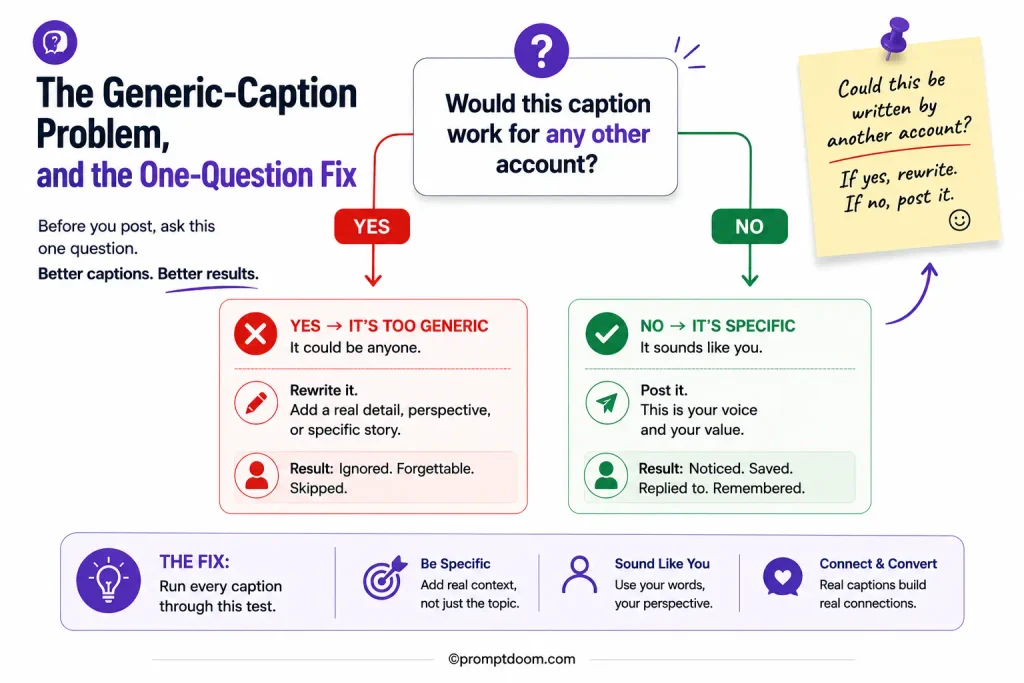
Before any prompt below, there’s a single question worth asking about whatever comes back: would this caption work, word for word, for a different account in a different city selling something else? If the honest answer is yes, the caption isn’t ready, regardless of how polished it sounds. This is the same failure mode across niches — a salon caption that never names the actual service, a coffee shop caption that never mentions the actual product, a fitness caption built entirely from stock motivational language. The fix each time is the same: force one real, specific detail into the caption that couldn’t apply to anyone else.
See Also – AI Prompts for Writing LinkedIn Posts That Don’t Sound Like AI (2026 Guide)
The Universal Instagram Caption Prompt
Prompt: “Write an Instagram caption for a [format: single photo / Reel / carousel] post about [specific subject — not just the general topic, but the actual thing in the post]. Here’s one real detail only I would know: [a specific fact, moment, or observation about this exact post]. Audience: [who you’re actually trying to reach]. Tone: [2-3 words, e.g. ‘warm but direct’]. Structure: a hook in the first sentence, 2-4 sentences of story or value, then a clear call to action asking the reader to [comment/save/share/click link]. Don’t use generic openers like ‘Exciting news!’ or phrases like ‘living my best life.’ Keep it under [word count].”
The one line that matters most in that prompt is the real detail — a specific fact, moment, or observation the model has no way to guess on its own. Without it, ChatGPT fills the gap with the same handful of generic phrases every account already overuses. With it, the caption has something in the first sentence that couldn’t have come from anywhere else.
Format-Specific Variants
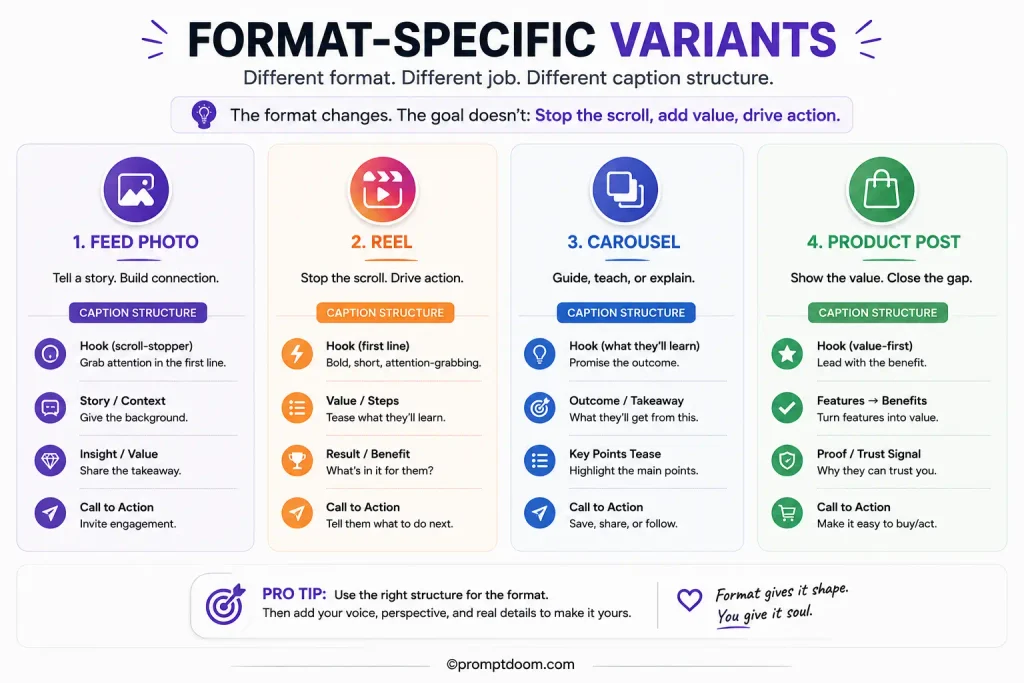
- For a single feed photo, keep the caption tight and save-worthy: “…Structure this as a short, save-worthy caption: one punchy hook line, then 2-3 sentences max. This needs to work as a caption people screenshot or save, not just scroll past.”
- For a Reel, the caption supports a video that’s already doing the work in its first 1.5 seconds: “…This caption goes under a Reel where the hook is already delivered on-screen in the first second. Write the caption to add context or a twist the video doesn’t already show, not to repeat what’s visible.”
- For a carousel, the caption should complement slide-by-slide reading, not summarize it: “…This is for a carousel with [number] slides covering [topic]. Write a caption that sets up why someone should swipe through, without repeating what each individual slide already says.”
- For a product or launch post, the goal is selling without reading like an ad: “…Frame this around the specific problem the product solves for [audience], not a feature list. Mention the real detail I gave you before any generic selling language.”
- For a festival or seasonal occasion post, specificity is what separates it from the flood of identical holiday captions: “…Include one personal or business-specific detail related to this occasion — not just a generic well-wish that every other account is also posting today.”
Instagram Caption Prompt – A Worked Example
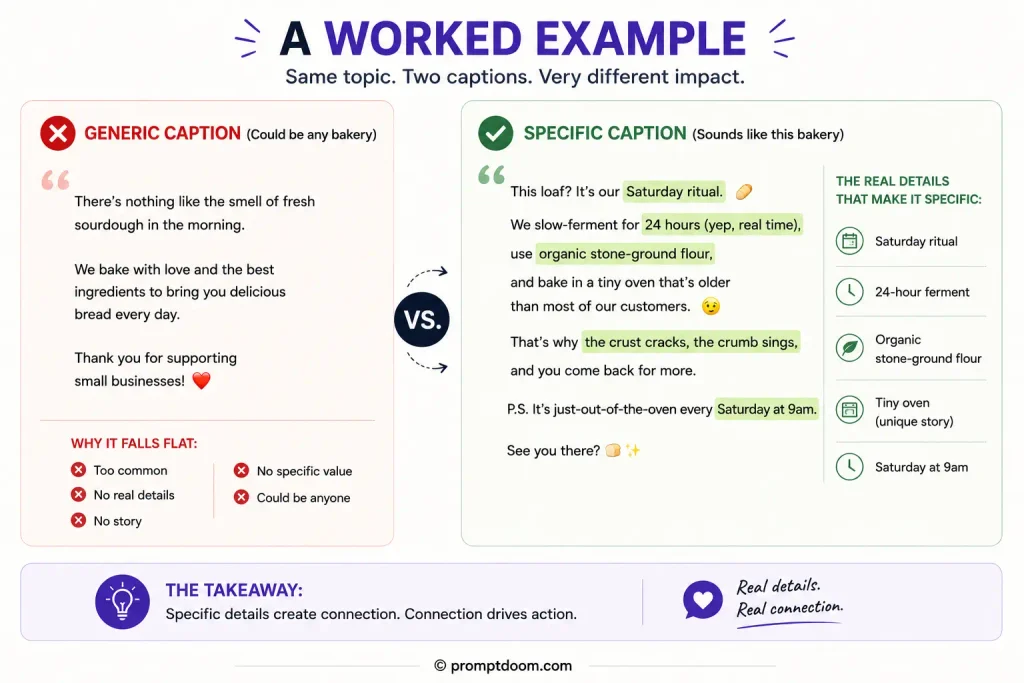
Generic prompt: “Write an Instagram caption for my bakery’s new sourdough bread.”
Generic result: “Fresh from the oven! Our new sourdough is here and it’s absolutely delicious. Come try it today! #bakery #sourdough #freshbread”
Using the universal prompt, with a real detail added: “Write an Instagram caption for a single photo post about our new sourdough loaf. Here’s one real detail only I would know: this recipe took 14 failed attempts before the crust finally came out right, and we started selling out of it within an hour on day one. Audience: local regulars who follow us for behind-the-scenes bakery content. Tone: proud, a little self-deprecating. Structure: hook, 2-3 sentences, CTA asking people to comment which bake they want to see documented next. Under 80 words.”
Result: “Attempt 14 was the one that finally worked. Fourteen loaves of sourdough that weren’t quite right before this crust came out the way I’d been picturing it for weeks — and it sold out in under an hour on its first day. If you want to see the next thing I’m stubbornly trying to perfect, tell me in the comments what to document next.”
The second caption couldn’t be posted by any other bakery, because it’s built entirely from a detail no other bakery has. That’s the actual mechanism behind a caption that reads as authentic rather than templated — not a cleverer sentence structure, just one real fact the prompt was given permission to build around.
See Also – 100 Best AI Image Prompts for 2026 (Nano Banana, Midjourney, Gemini, ChatGPT)
The Hashtag Prompt (Run Separately)
Hashtags do a different job than the caption itself, so they work better as a separate prompt rather than tacked onto the end of the caption request: “Give me 10 Instagram hashtags for a [niche] post targeting [audience]. Mix: 2 broad reach tags, 4 medium-competition tags, 4 specific niche tags relevant to this exact post.” Running this separately also makes it easy to reuse and adjust the hashtag set across multiple posts without regenerating the caption each time.
The Pinned First Comment Prompt
A tactic worth using alongside the caption itself: Instagram reads the text of comments for search relevance, and replies to a comment count as engagement signals, which makes a well-written first comment more useful than it might seem. “Write a first comment for this post about [topic] that I’ll pin. Naturally include 3-4 words or phrases someone would actually search to find content like this, and end with a genuine question that invites replies. Keep it conversational, not keyword-stuffed.”
What the Evidence Suggests
Across current guidance on Instagram captions, the recurring theme isn’t a missing trick or a magic phrase — it’s that generic captions and generic prompts are the same problem from two directions. A prompt with no real, specific detail produces a caption with no real, specific detail, and that gap is exactly what a reader (and increasingly, the algorithm rewarding saves and shares over passive likes) notices immediately. Structuring the prompt around the actual post format, and refusing to submit a caption that fails the “could this be any other account” test, consistently produces something worth publishing without a full rewrite.
Frequently Asked Questions
Why does my ChatGPT Instagram caption always sound generic?
Usually because the prompt only stated the general topic, not a specific real detail about that exact post. Without something concrete to build from, ChatGPT defaults to the same phrases every account already overuses.
Should Reels and feed photos use the same caption prompt?
No — a Reel’s caption should add something the video hasn’t already shown in its first second, while a feed photo caption needs to work as a standalone, save-worthy piece of text, so the prompt structure should differ by format.
How do I know if a caption is too generic to post?
Ask whether the caption, unchanged, could realistically be posted by a different account in a different city selling something else. If yes, it’s missing the specific detail that would make it clearly yours.
Should hashtags be generated in the same prompt as the caption?
It’s usually cleaner to generate them separately, since hashtags serve a different purpose (reach and discoverability) than the caption itself, and a dedicated prompt makes it easier to reuse and adjust the hashtag set across posts.
Does the first comment on a post actually matter for reach?
Yes — Instagram reads comment text for search relevance, and replies to a comment count as engagement, so a well-written, keyword-relevant first comment can support a post beyond what the caption alone does.
Do I need ChatGPT Plus to write good Instagram captions?
No — the free tier is sufficient for caption writing; the quality difference comes from how specific the prompt is, not which ChatGPT tier is generating the response.