
Two people can type a request into the same AI tool and get results so different they barely seem related — one gets a generic, forgettable paragraph, the other gets something specific and immediately usable. Neither is using a “better” version of ChatGPT or Gemini. The tool is identical. What differs is the prompt, and understanding why that single variable matters this much is the difference between finding AI tools occasionally useful and finding them genuinely reliable.
Most explanations of this stop at “good prompts get better results,” which is true but doesn’t actually explain anything. The more useful answer starts one level deeper, with what a language model is actually doing when it generates a response.
What a Prompt Actually Does
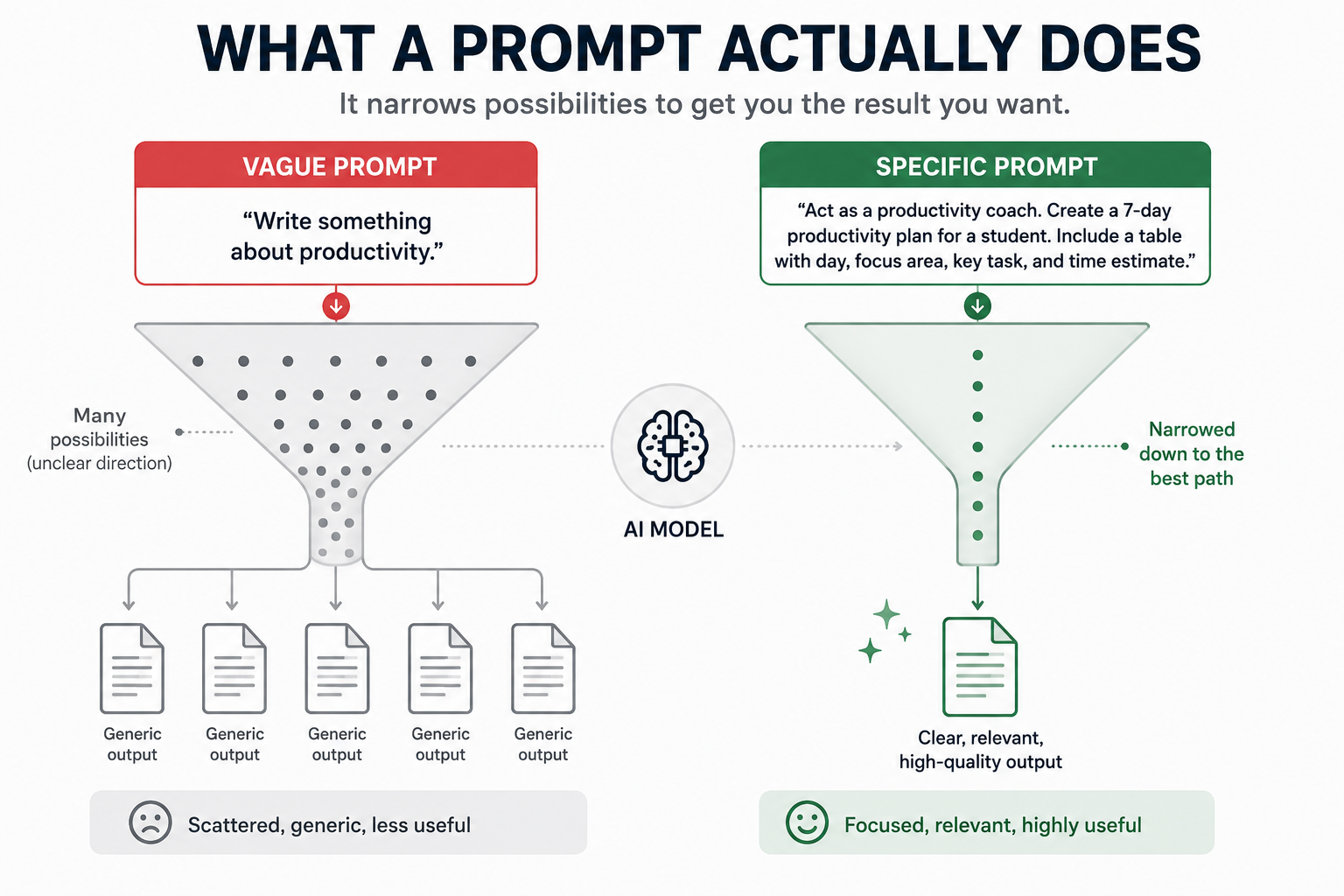
A language model doesn’t understand a request the way a person does. It’s predicting the most statistically likely continuation of the text it’s been given, based on patterns learned from enormous amounts of writing. A prompt isn’t a question in the way you’d ask a colleague a question — it’s the starting context that determines which patterns the model draws from next.
This is why a vague prompt produces a vague answer, and it’s not a flaw in the model so much as a direct consequence of how it works. Asked to “write a product description,” the model has no signal about which product, which audience, or which tone to draw from, so it produces the statistical average of every generic product description it’s seen — technically coherent, entirely forgettable. Asked to “write a product description for a stainless steel water bottle aimed at hikers who care about durability, in a confident, no-fluff tone,” the model has specific signals pulling it toward a narrower, more relevant set of patterns, and the output reflects that narrowing.
Why This Matters More Than Which Tool You Use
It’s tempting to assume output quality is mostly a function of which AI tool is more advanced, and model capability genuinely does matter for some tasks. But for the large majority of everyday requests — writing, summarizing, planning, coding help — the gap between a mediocre result and a genuinely useful one is far more often explained by prompt quality than by model choice. A specific, well-structured prompt run through a mid-tier model frequently outperforms a vague, one-line prompt run through the most capable model available, simply because the more capable model still has nothing specific to work from.
This reframes what “learning AI” actually means for most people. It’s less about learning a particular tool’s interface and more about learning to communicate a request completely enough that there’s only one reasonable way to interpret it.
The Four Things a Good Prompt Usually Includes
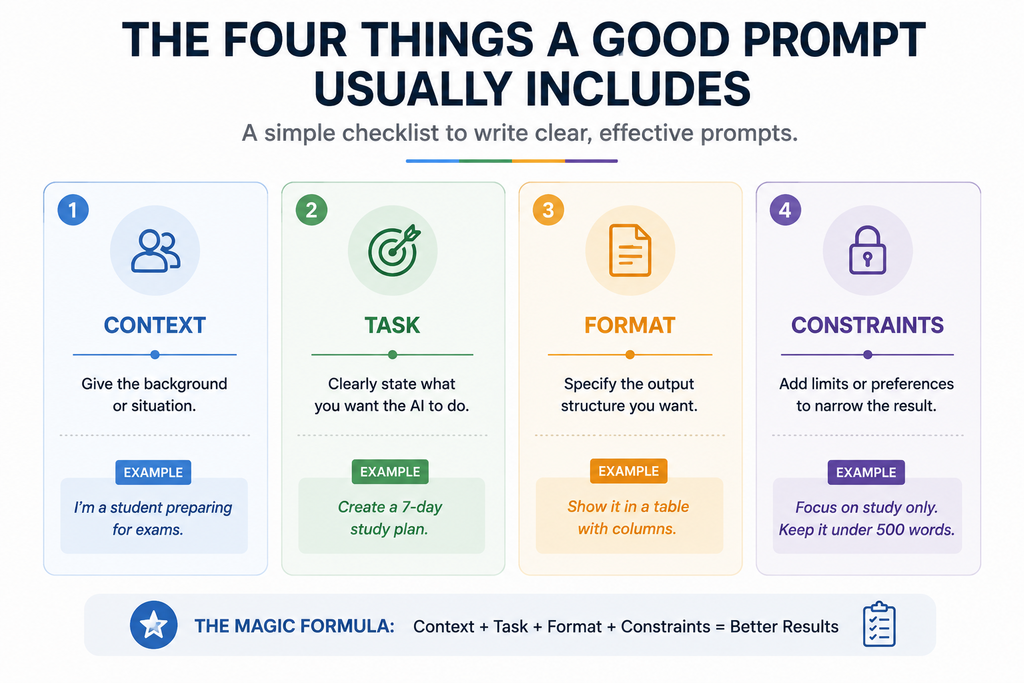
Across nearly every effective prompt, four elements tend to show up in some form, even when they’re not labeled explicitly:
- Context — relevant background the model wouldn’t otherwise know: your audience, your industry, your constraints.
- Task — the specific action requested, stated concretely rather than vaguely (“summarize the three main risks,” not “tell me about this”).
- Format — how the output should be structured: a list, a table, a specific word count, a particular tone.
- Constraints — anything that should be avoided or specifically included, such as “don’t use jargon” or “keep it under 100 words.”
None of these need to appear as literal labeled sections in a prompt — they just need to be present in substance. A single well-written sentence can carry all four; a five-sentence prompt can still be missing one and produce a noticeably weaker result.
A Worked Example: Same Request, Two Prompts
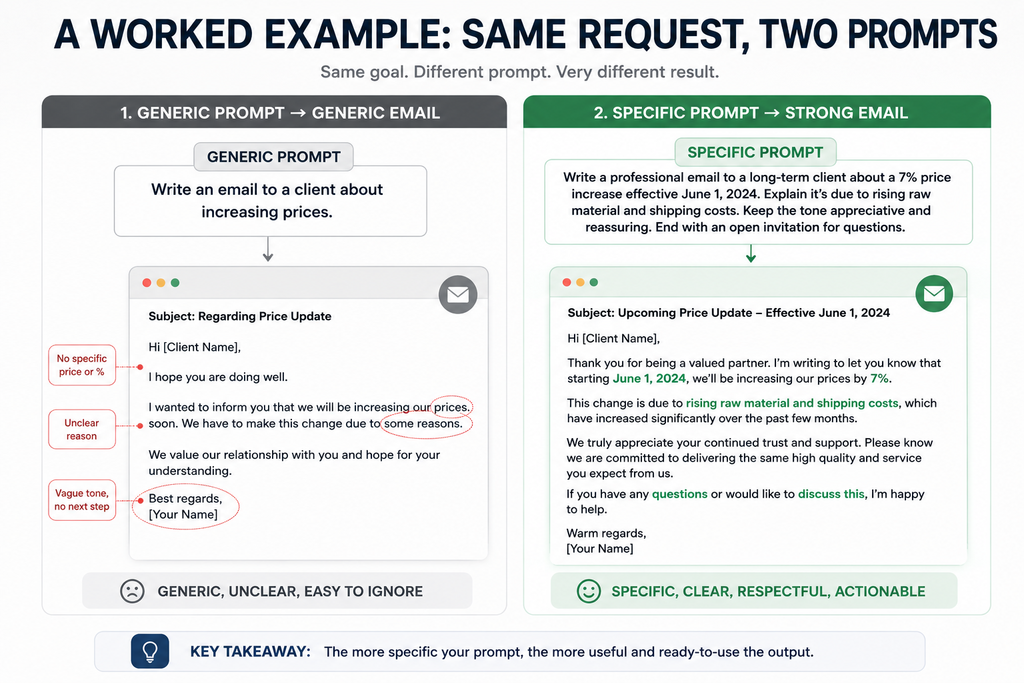
Vague prompt: “Write an email about our new pricing.”
Resulting output: A generic, three-paragraph email announcing “exciting updates” to pricing, with no specific numbers, no clear audience, and a closing line inviting the reader to “reach out with any questions” — technically an email about pricing, but not one that could be sent to an actual customer without a complete rewrite.
Specific prompt: “Write a short email to existing customers announcing that our monthly plan is increasing from $15 to $18, effective next billing cycle. Acknowledge the increase directly rather than burying it, explain briefly that it reflects added storage and support capacity, and reassure customers that their current features aren’t changing. Keep it under 120 words, professional but warm tone, no corporate jargon.”
Resulting output: A tight, specific email that states the exact price change in the first two sentences, gives one concrete reason rather than vague corporate language, and closes with a direct reassurance about existing features — usable with minimal editing.
The task in both cases was “write a pricing email.” The difference in usefulness between the two outputs traces entirely to the difference in what the prompt actually specified — nothing about the underlying AI model changed between the two attempts.
The Real Cost of Skipping This
The practical cost of a vague prompt isn’t just a worse first draft — it’s the compounding time spent on follow-up corrections, each of which is itself often another vague prompt (“make it better,” “more professional”), producing another round of guessing rather than a targeted fix. Someone who consistently writes specific, complete prompts tends to get a usable result in one or two exchanges. Someone who consistently writes vague ones often needs five or six rounds to arrive at the same place, if they get there at all — and the time spent iterating usually outweighs whatever time was “saved” by typing a shorter prompt in the first place.
There’s a learning benefit too, separate from any single request. Writing a specific prompt requires clarifying, to yourself, exactly what you actually want before you ask for it — a discipline that tends to produce clearer thinking about the task itself, independent of whether AI is even involved.
What This Means Going Forward
Prompting well isn’t a technical skill reserved for developers or so-called prompt engineers — it’s closer to the skill of briefing a capable colleague clearly, a skill most people already have some version of in other contexts and simply haven’t yet transferred to how they talk to AI tools. The four elements above (context, task, format, constraints) work as a quick mental checklist before sending any request: if a prompt is missing two or three of them, that’s usually a more reliable predictor of a disappointing result than anything about the AI tool itself.
What the Evidence Suggests
Across current guidance on this topic, one point holds regardless of which specific framework or acronym a given source uses: prompt specificity is the variable that most reliably separates a generic AI output from a genuinely useful one, more consistently than which tool or model produced it. The underlying reason is mechanical, not mysterious — a model without specific input has nothing to narrow its response around, and defaults to the statistical average of everything it’s seen on the topic. Treating a prompt as a complete brief, rather than a quick question, is the single habit most responsible for the gap between people who find AI tools occasionally useful and people who rely on them daily.
Frequently Asked Questions
Why do I get such different results from the same AI tool as someone else?
Because a language model generates its response based on the specific text of the prompt it receives, not on any shared understanding of intent. Two different prompts about the same topic give the model two different sets of patterns to draw from, which produces two different outputs.
Is prompt writing a technical skill I need training for?
Not really — it’s closer to the everyday skill of clearly briefing another person on a task, applied to an AI tool instead. Most people already do some version of this in emails or instructions to colleagues; the main shift is doing it just as deliberately when prompting AI.
Does a more advanced AI model make prompting less important?
No — more capable models still generate output based on the specificity of what they’re given. A vague prompt to an advanced model still has nothing specific to narrow its response around, so specificity remains the bigger lever in most everyday tasks.
What’s the fastest way to improve a weak prompt?
Check whether it’s missing context (relevant background), a specific task, a stated format, or a clear constraint. Adding whichever of those four is missing usually improves the result more than rewriting the whole prompt from scratch.
Why does a longer prompt sometimes produce a worse result than a shorter one?
Length isn’t the deciding factor — specificity is. A short prompt that clearly states the task, format, and key constraint often outperforms a long prompt that’s vague or repetitive, since extra words without added specific detail don’t narrow the model’s response any further.
Does this apply to image-generation prompts too, not just text?
Yes — the same underlying principle applies. A vague image prompt gives an image model no specific style, lighting, or composition to work from, producing a generic result, while a specific prompt narrows the output the same way it does for text.