
By early 2026, a widely cited industry analysis estimated that more than half of long-form LinkedIn posts showed strong signs of being AI-generated, and one journalist who manually reviewed 200 posts across 50 profiles judged roughly three-quarters of them to be AI-written. Whatever the exact figure, the underlying pattern is easy to notice just by scrolling: the same dramatic openers, the same rhetorical questions, the same “here’s what I learned” structure appearing across accounts that have nothing else in common. Readers have gotten fast at spotting it, and in trust-heavy fields like healthcare and government, one analysis found human-written posts significantly outperforming AI-flagged ones on engagement.
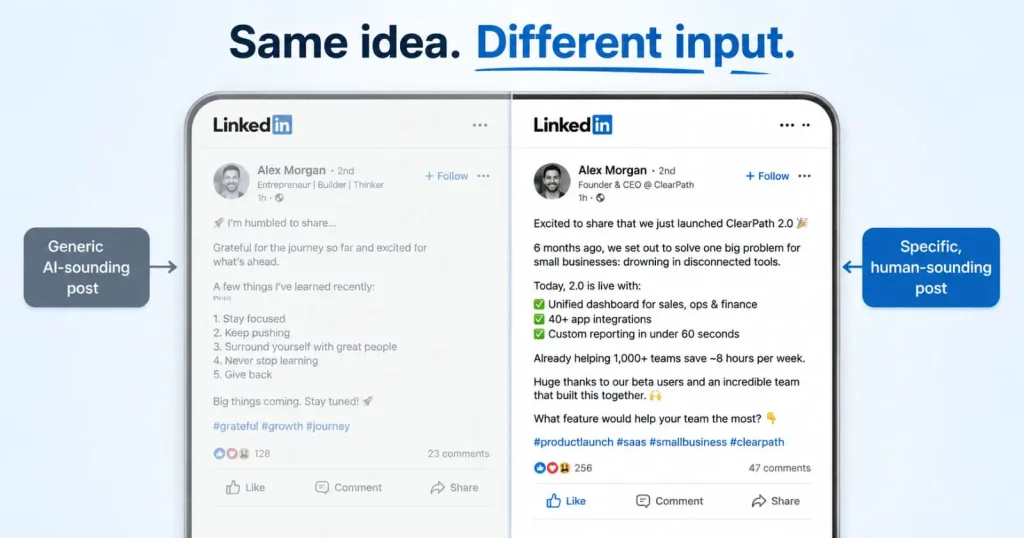
The instinct this creates — avoid AI entirely — misses the actual fix. The problem isn’t that AI helped write the post. It’s that most people ask AI to write the post from nothing, and AI can only work with what it’s given. Fed nothing but a topic, it produces the statistical average of everything it’s read on that topic, which is precisely why so many AI-assisted posts sound interchangeable. The prompts below are built around a different approach: feeding AI your actual specifics so it has something real to organise, rather than asking it to invent a voice from a blank prompt.
Why AI Defaults to Sounding Like AI
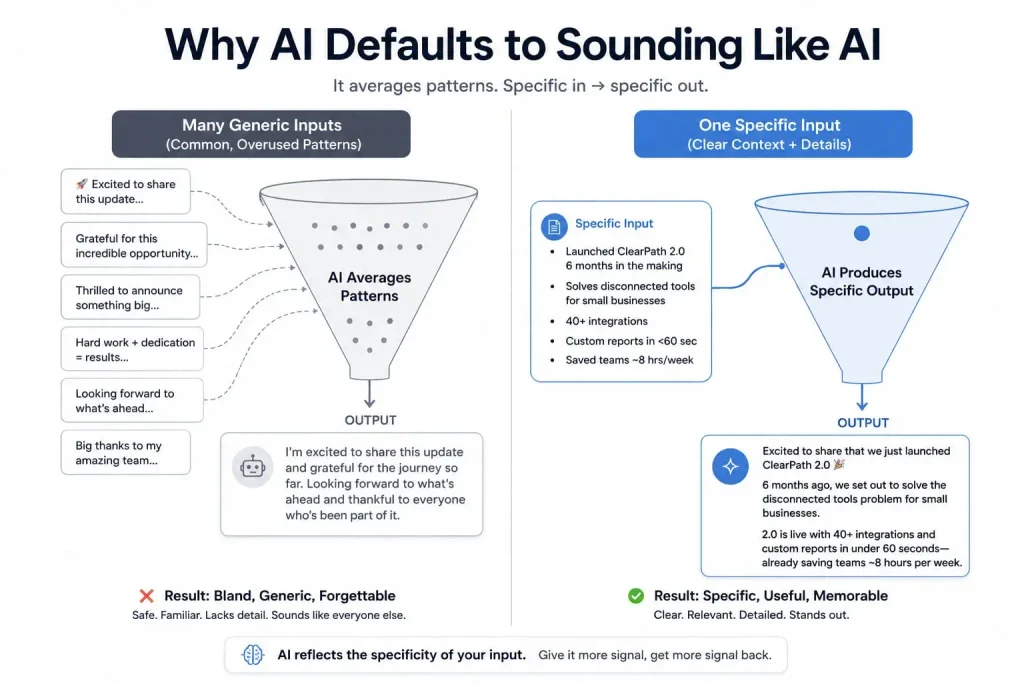
When a language model is asked to write a LinkedIn post with only a topic and no other input, it draws on patterns that appear disproportionately often across the professional content it’s seen — inspirational openers, tidy three-point lists, an engagement question tacked onto the end. None of these patterns are wrong in isolation. The problem is density: one em dash is normal punctuation, but a dash in nearly every sentence, combined with no specific detail a human would actually know, is what reads as manufactured. The fix isn’t avoiding these patterns individually — it’s giving the model something specific enough that it doesn’t need to fall back on them.
The Core Input: Give AI Your Voice, Not Just Your Topic
Prompt: “Here’s a rough, unedited version of what I want to say, in my own words: [paste your raw thoughts, voice memo transcript, or a few bullet points — don’t worry about polish]. Turn this into a LinkedIn post that keeps my actual phrasing and ideas intact. Don’t add generic openers, don’t add an engagement question at the end, and don’t smooth out every sentence to the same length and rhythm.”
This single prompt does more to prevent AI-sounding output than any “make it sound human” instruction applied afterward, because it removes the blank-page problem that forces AI to default to generic patterns in the first place. A two-minute voice memo transcribed into rough notes, or even a messy paragraph typed in five minutes, gives the model real material to organise rather than invent.
Prompts for Specific Post Types
The lesson-learned post. “I want to write about [specific situation/mistake/decision]. Here’s what actually happened: [details]. Here’s what I’d do differently: [specifics]. Write this as a LinkedIn post that includes the actual details I gave you — don’t generalise them into a broader ‘lesson.’ Keep one specific number, name, or detail from what I described.”
The opinion/hot-take post. “I think [specific opinion] about [topic], and here’s why: [your actual reasoning]. Write this as a direct, confident LinkedIn post. Don’t soften it with ‘in my opinion’ or ‘just my two cents’ — state it plainly, the way I would in a conversation with a colleague I trust.”
The announcement post. “I’m announcing [specific news]. Here are the real details: [facts]. Write a LinkedIn post that leads with what actually changed, not with excitement language like ‘thrilled to announce.’ If I want to convey excitement, tell me where to add a specific reason I’m excited, not a generic adjective.”
The industry-commentary post. “Here’s a recent development in [industry]: [what happened]. Here’s my specific take on what it means for [audience]: [your reasoning]. Write this as a LinkedIn post grounded in that specific take, not a general summary of the news.”
Prompts for Fixing an Already-Generic Draft
Sometimes the AI-sounding draft already exists — you or a colleague generated it from a bare prompt and now need to fix it rather than start over.
Prompt: “Here’s a LinkedIn post draft: [paste draft]. Rewrite it to remove any generic opener, any tacked-on engagement question, and any sentence that could apply to literally anyone in this industry. Where a sentence is vague, ask me a specific question so I can replace it with a real detail instead of guessing one.”
This prompt is deliberately structured to make ChatGPT ask you for missing specifics rather than inventing plausible-sounding ones — since a fabricated detail (a made-up client name, a specific number that didn’t happen) is worse for credibility than a generic sentence, not better.
A Diagnostic Checklist: Does Your Draft Sound Like AI?
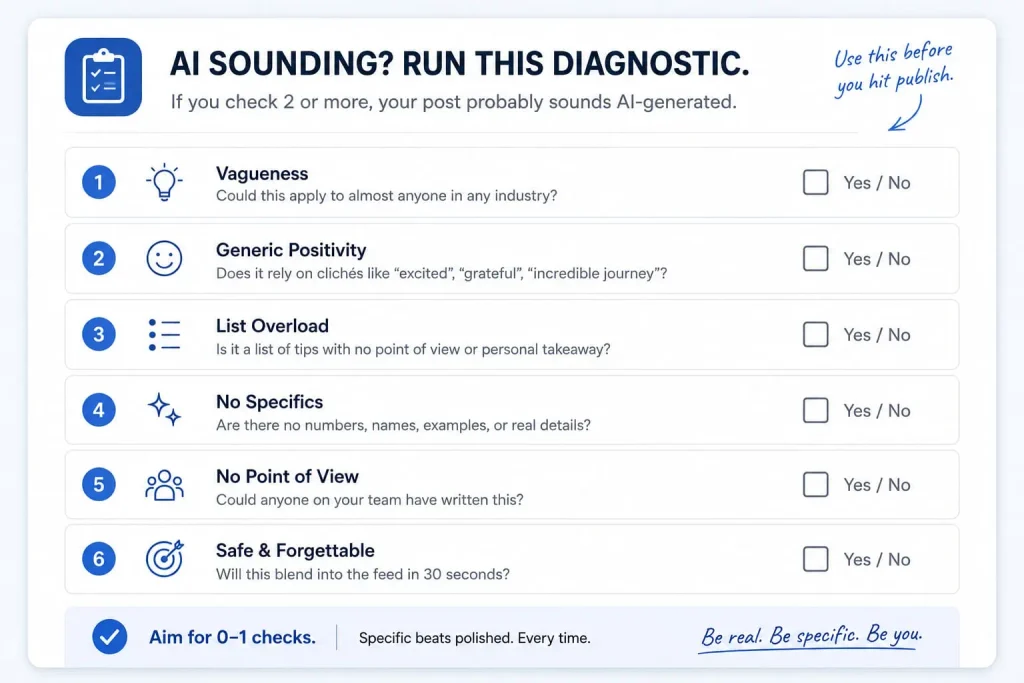
Before publishing, scan a draft for these recurring patterns, each of which is common enough on its own to be unremarkable, but adds up quickly in combination:
- An opener like “In today’s fast-paced world” or “As leaders, we often forget”
- A numbered list where each point is a single abstract sentence with no story or specific attached
- An engagement question tacked on at the end that doesn’t connect to anything specific in the post (“What are your thoughts?”)
- Every sentence roughly the same length, with no short, blunt lines breaking up the rhythm
- Zero proper nouns — no real name, company, city, or number anywhere in the post
- Words like “leverage,” “delve,” “foster,” or “landscape” appearing where a plainer word would do
One or two of these in isolation rarely gives a post away. Several together, with nothing specific anchoring the post to a real event or person, is the actual signal readers are picking up on.
Before/After: The Same Idea, Two Different Inputs
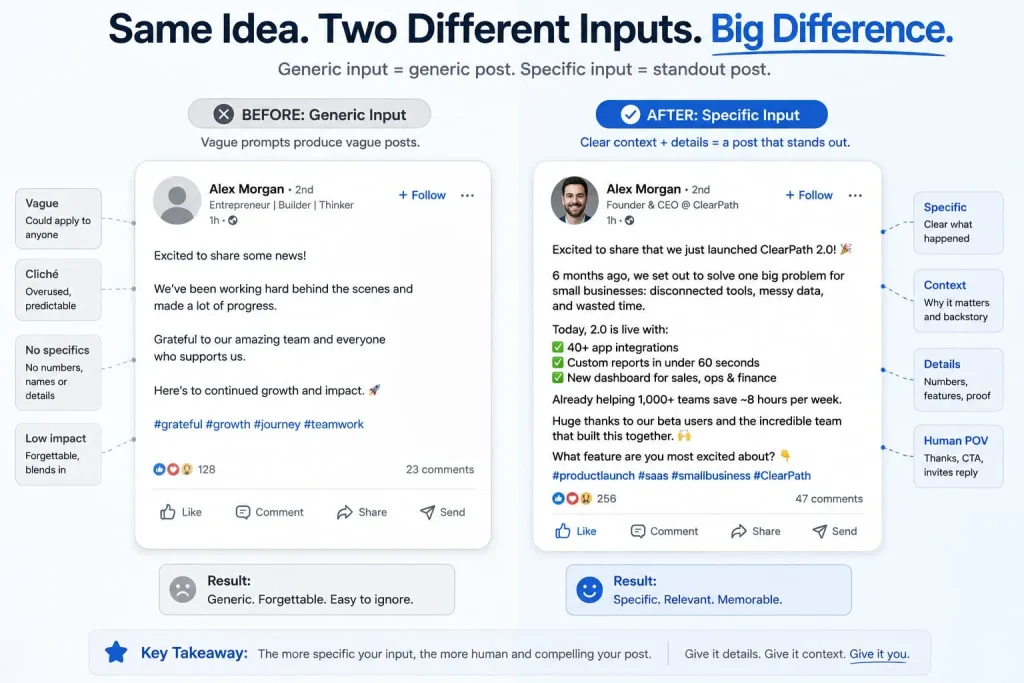
Bare prompt: “Write a LinkedIn post about learning to delegate better as a manager.”
Generic output: “As leaders, we often forget the power of delegation. 🚀 Here’s what I learned: 1. Trust your team. 2. Let go of control. 3. Growth happens when you empower others. What’s your experience with delegation? Drop a comment below! 👇”
Specific-input prompt: “I want to write about learning to delegate better. Here’s what happened: I used to rewrite every piece of copy my junior writer sent me before it went out, which meant nothing shipped without going through me first. Last month I stopped editing her drafts and just gave feedback after publishing instead. Her writing got noticeably better within three weeks, and I got back about five hours a week. Write this as a LinkedIn post keeping these actual details.”
Resulting output: “I used to rewrite every piece of copy my junior writer sent me before it shipped. Every single post went through me first. Last month I stopped. I gave feedback after publishing instead of before. Her writing improved within three weeks — genuinely, not just politely better. And I got about five hours a week back that I’d been spending editing instead of doing my own work. The instinct to control quality by controlling every draft was costing more than it was protecting.”
The second version contains a real number (three weeks, five hours), a real role (junior writer), and a real behavior change — none of which the AI invented; all of it came from the input. That’s the mechanical difference between a post that sounds generic and one that doesn’t, and it has nothing to do with which AI tool was used.
What This Means for How You Should Actually Use AI Here
The pattern across every prompt above is the same: AI should organise and tighten what you already know, not invent a voice or a story from a bare topic. Used that way — voice memo or rough notes in, structured post out — AI genuinely speeds up the writing process without producing the generic output readers have started recognising on sight. Used the other way, starting from nothing and asking AI to “sound human” after the fact, tends to produce a differently generic post rather than a genuinely specific one, because there was never any real material for it to work from.
Pingback: ChatGPT Prompt for Instagram Captions (That Sound Like You, Not a Template) - Prompt Doom