
How to Use AI to Write Product Descriptions in 2026: Most sellers who try using AI to write product descriptions end up with the same result: technically correct copy that reads like every other technically correct copy on the internet. The sentences are grammatical, the features are listed, and nothing about it makes a browsing customer stop scrolling. The problem usually isn’t the AI tool — it’s the prompt. AI models default to describing what a product is unless specifically instructed to explain what it does for the buyer, and that single gap is what separates a description that fills space from one that actually sells.
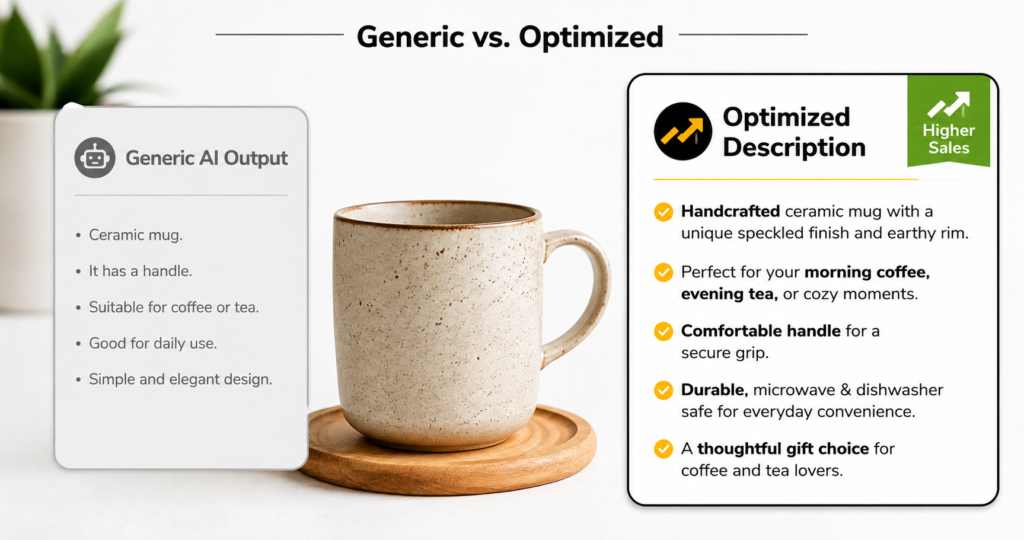
Closing that gap doesn’t require a better tool or a paid subscription. It requires feeding the AI the right inputs in the right order and asking it to solve a specific persuasion problem rather than simply “write a product description.” The framework below is built around that principle, and includes a full worked example so you can see the difference rather than just take it on faith.
Why AI-Generated Descriptions Default to Generic Copy
Left to its own devices, an AI model given only a product name and a few specs will produce a description that lists attributes in roughly the order they were given, dressed up with a handful of stock adjectives — “premium,” “durable,” “versatile.” This happens because the model has no information about who is buying the product, what hesitation they’re likely to have, or what makes this specific item different from the dozen similar ones a shopper has already scrolled past. Without that context, “sell this product” and “describe this product” produce nearly identical output.
The fix is to treat the AI less like a copywriter you hand a spec sheet to, and more like a copywriter you brief properly — the same way you would brief a human freelancer before expecting usable work back.
The Five-Part Input Framework
Before writing a single prompt, gather five categories of information. Skipping any one of them is the most common reason AI output ends up generic.
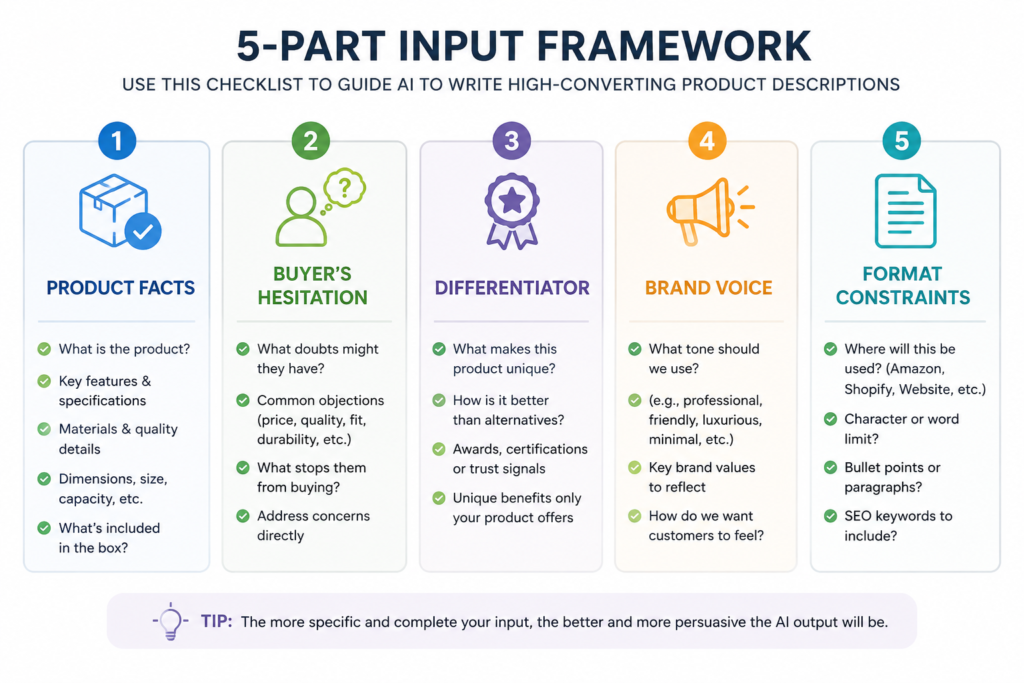
- Product facts — name, materials, dimensions, functionality, what’s included
- The buyer’s hesitation — the specific doubt or objection a shopper has before purchasing (price justification, durability doubt, sizing uncertainty, “will this actually work for my situation”)
- The differentiator — what makes this product different from the nearest three competitors, even if the difference is small
- Brand voice — three adjectives that describe how your brand sounds (playful, minimal, technical, warm) plus one thing to avoid (overly salesy, jargon-heavy)
- Format constraints — word count, whether bullet points are required, whether it needs to fit a specific platform’s character limit
Once you have these five inputs, the prompt writes itself — and, more importantly, so does the AI’s output.
The Prompt Template
Prompt: “Write a product description for [product name]. Facts: [list specs/materials/features]. The main hesitation a buyer has before purchasing this is: [hesitation]. What makes this different from similar products: [differentiator]. Brand voice: [three adjectives], and avoid sounding [thing to avoid]. Format: [word count / bullet points / platform]. Focus on what the product does for the buyer, not just what it is.”
That final instruction — “focus on what the product does for the buyer, not just what it is” — is doing the most work in this prompt. It’s the single line most generic AI product-copy prompts leave out, and it’s the reason so much AI-generated ecommerce copy reads as a feature dump rather than a pitch.
Before/After: Seeing the Difference in Practice
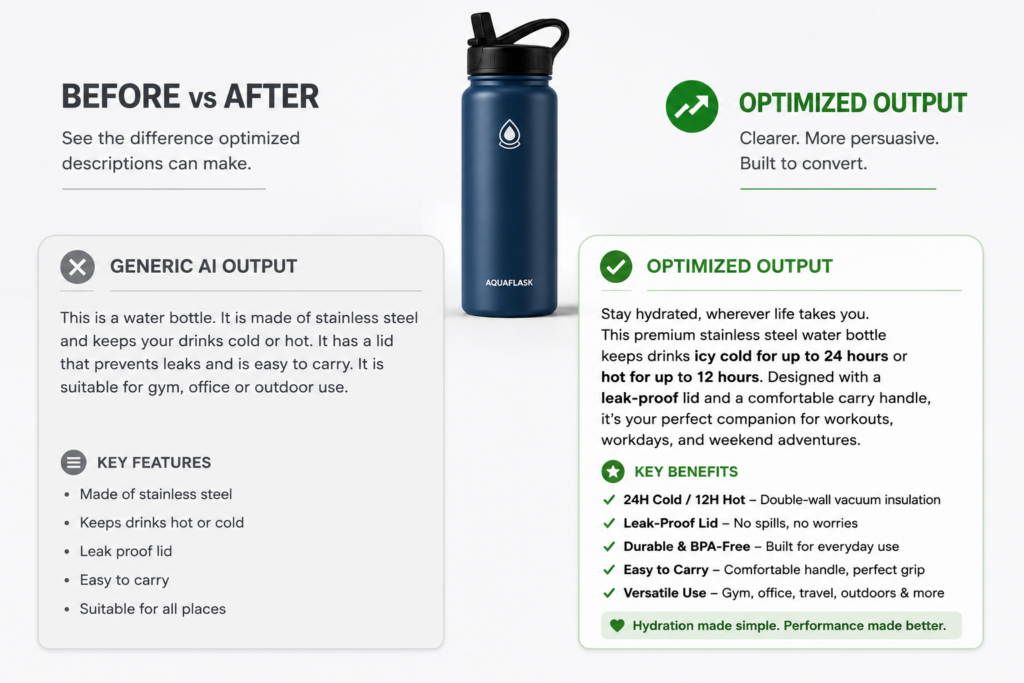
Inputs given to AI:
Product: insulated stainless steel water bottle, 750ml, double-wall vacuum insulation, keeps drinks cold 24 hours / hot 12 hours. Hesitation: buyers assume all insulated bottles perform about the same and hesitate to pay a premium price. Differentiator: leak-proof lid tested to survive being dropped in a bag with no seal failure. Brand voice: confident, straightforward, avoid overly technical language.
Generic AI output (prompt: “write a product description for this water bottle”):
“This 750ml stainless steel water bottle features double-wall vacuum insulation that keeps drinks cold for 24 hours and hot for 12 hours. Made from durable, high-quality materials, it’s perfect for everyday use, travel, or the gym. A great addition to your hydration routine.”
Optimized output (using the five-part framework prompt):
“Most insulated bottles claim all-day cold — until they leak in your bag. This one won’t. The 750ml stainless steel bottle keeps drinks cold for 24 hours and hot for 12, backed by a lid tested to hold a seal through repeated drops. If you’ve been burned by a bottle that soaked your laptop bag, this is the one that finally does what it promises.”
The facts are identical in both versions. What changed is that the second version opens with the buyer’s actual hesitation (skepticism that this bottle performs differently from cheaper alternatives), leads with the differentiator that resolves it (the tested leak-proof lid), and closes on the emotional payoff (no more ruined bags) instead of a generic call-to-action. Nothing was invented — every claim in the optimized version traces back to a fact or hesitation that was fed into the prompt.
Common Mistakes AI Makes by Default
Even with a good prompt, AI-generated product copy has a few recurring failure modes worth watching for before you publish anything.
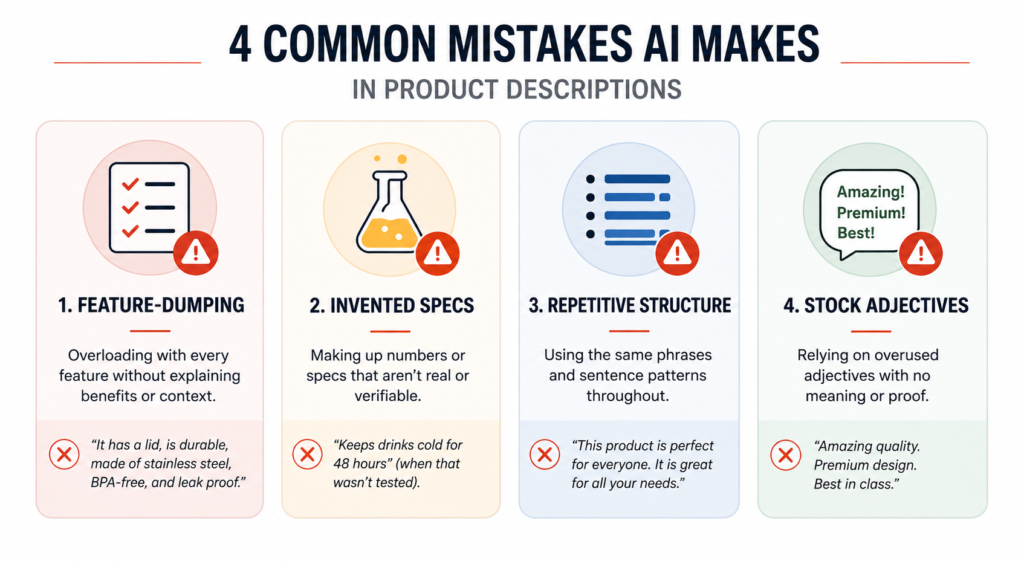
Feature-dumping. Left unchecked, AI tends to list every spec provided, in the order given, rather than prioritising the two or three that actually matter to a buyer’s decision. If your prompt gives ten facts, expect the output to mention all ten unless you explicitly ask it to select only the most persuasive ones.
Invented specifications. If your product facts are incomplete, some models will fill gaps with plausible-sounding but unverified details — a material, a certification, a comparison claim. Every generated description needs a human fact-check pass against your actual product sheet before publishing, since a wrong claim in a product description can create real return and complaint problems.
Repetitive structure across a catalog. If you’re generating descriptions for dozens of products with the same prompt template and only swapping the product name, the sentence structure and rhythm will start to feel identical across your store, which readers notice even if they can’t articulate why. Varying the differentiator and hesitation inputs product-to-product avoids this.
Overuse of stock adjectives. Words like “premium,” “elevate,” “seamless,” and “game-changing” show up disproportionately in AI-generated marketing copy. A quick pass to cut or replace these with something more specific to your product noticeably improves how the copy reads.
What This Means for Sellers Running Large Catalogs
For a store with hundreds or thousands of SKUs, writing every description manually isn’t realistic, which is exactly the situation AI is genuinely useful for — provided the five-part framework is applied consistently rather than abandoned after the first few products. A practical middle ground many sellers use: apply the full framework by hand to your ten to twenty highest-traffic or highest-margin products, where the quality difference has the most financial impact, and use a lighter, templated version of the prompt for the long tail of lower-priority listings. This concentrates editing effort where it earns the most return rather than spreading it evenly across a catalog where most products get little search traffic anyway.
What the Evidence Suggests
Across the sources and examples above, the recurring theme is that AI output quality for product descriptions is almost entirely a function of input quality, not model choice. A well-specified prompt — facts, hesitation, differentiator, voice, format — consistently produces copy closer to what a trained copywriter would write, regardless of which AI tool generates it. The inverse is also true: even the most capable AI model produces generic output when given only a product name and spec list, because it has no signal about what actually needs persuading.
FAQ Section
Can AI write product descriptions that actually sound like a specific brand’s voice?
Yes, if the brand voice is explicitly described in the prompt — typically as three descriptive adjectives plus one thing to avoid. Without that input, AI defaults to a neutral, generic marketing tone that doesn’t reflect any particular brand.
Is it safe to publish AI-generated product descriptions without editing them?
No. AI models can occasionally generate plausible-sounding but inaccurate specifications when the input facts are incomplete, so every description should be checked against the actual product sheet before publishing, particularly for claims about materials, dimensions, or certifications.
How is writing a product description different from other AI copywriting tasks?
Product descriptions need to resolve a specific purchase hesitation within a very short space, often just a few sentences or bullet points, which makes vague prompts more damaging here than in longer-form content where the AI has more room to eventually get specific.
Do I need to write a new prompt for every single product?
Not entirely — the five-part framework structure stays the same, but the buyer’s hesitation and differentiator inputs should change per product, or descriptions across your catalog will start to feel templated and repetitive to shoppers browsing multiple listings.
What’s the biggest mistake sellers make when using AI for product descriptions?
Treating the AI like a vending machine — typing a product name and expecting sales-ready copy back. The quality of the output is almost entirely determined by the quality and specificity of the input, particularly the buyer’s hesitation, which most sellers skip entirely.
Should product descriptions be optimized for SEO or for conversion?
Both, though they’re not in conflict. Primary keywords can usually be worked naturally into the opening sentence or a specification line without disrupting the persuasive structure; the framework in this article is compatible with standard on-page SEO practices for product pages.