
Most AI prompt libraries for SEO content read like a junk drawer: forty or fifty prompts, loosely grouped by topic, with no sense of which one to reach for first. In practice, a piece of content moves through the same handful of stages every time — you research a keyword, build a brief, draft, optimize, publish, and eventually refresh it — and the prompts that help most are the ones matched to the stage you’re actually in. This library is organized that way on purpose, so you can work through it in order on your next piece rather than scrolling to find something that fits.
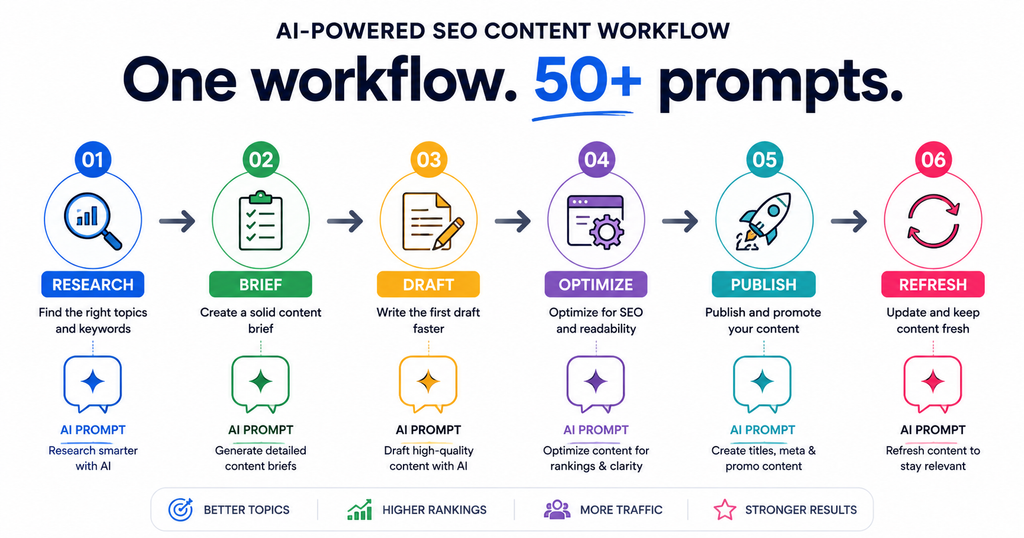
One thing worth stating up front: none of these prompts are a substitute for editorial judgment. Google’s current AI content guidance is explicit that quality and helpfulness determine rankings, not whether AI was involved in producing a page — but that same guidance draws a hard line around thin, unreviewed, mass-produced content, regardless of what generated it. The prompts below are built to produce a strong starting point, not a finished, publish-ready article. The closing section of this guide covers exactly where that line sits.
Stage 1: Keyword Research and Search Intent (7 prompts)
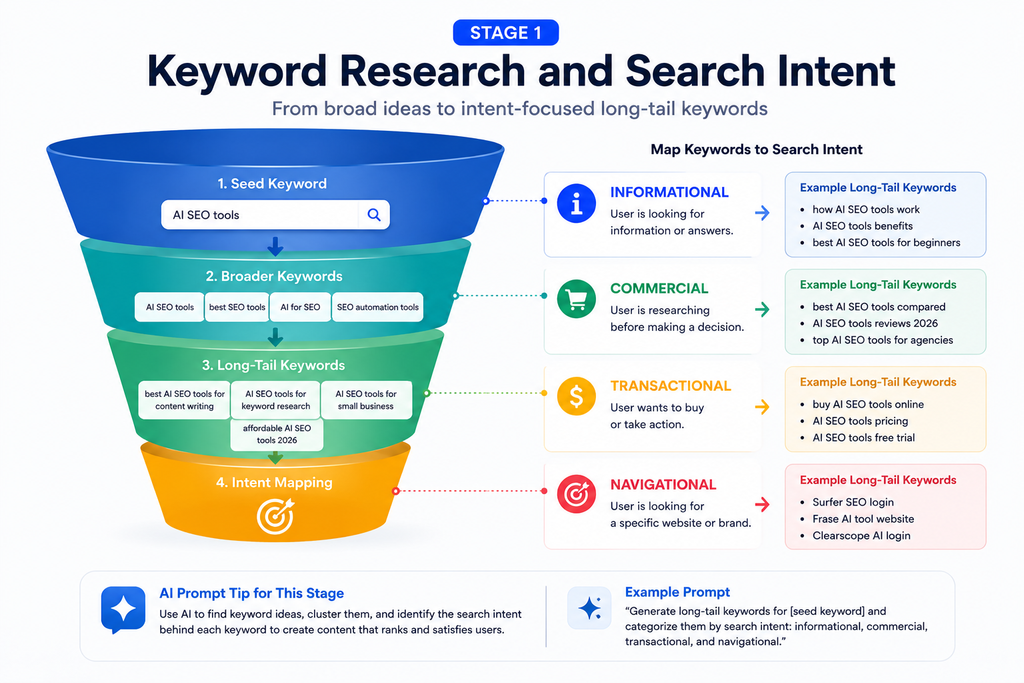
- “List 15 long-tail keyword variations for ‘[seed topic]’, grouped by search intent (informational, commercial, transactional, navigational).”
- “Create semantic keyword clusters for ‘[topic]’, grouped by subtopic, so I can plan a pillar page and supporting articles.”
- “Given this primary keyword: ‘[keyword]’, list 10 related questions people are likely to search that this article should answer.”
- “Compare the likely search intent behind these two similar keywords: ‘[keyword A]’ and ‘[keyword B]’, and tell me if they should be one article or two.”
- “Suggest 5 blog topic angles for ‘[broad topic]’ that go beyond the most obvious, commonly covered angle.”
- “Here’s a list of keywords I’m considering: [paste list]. Group them by topic cluster and flag any that likely target the same search intent, so I can avoid publishing overlapping content.”
- “For the keyword ‘[keyword]’, list the kinds of SERP features (featured snippet, People Also Ask, video carousel, local pack) that typically appear for this type of query.”
Stage 2: Content Briefs and Planning (6 prompts)
- “Create a content brief for an article targeting ‘[primary keyword]’, including target audience, search intent, suggested word count, and 3 subtopics competitors are likely covering.”
- “Based on this primary keyword and audience: ‘[keyword]’, ‘[audience]’, suggest a unique angle or information gap this article could fill that generic competing content likely misses.”
- “Create a detailed outline for a [word count]-word article on ‘[topic]’, with H2/H3 headings organized around actual search intent rather than generic subheadings.”
- “Suggest 5 internal linking opportunities I should plan for an article on ‘[topic]’, based on common related subtopics in this niche.”
- “List the entities (people, organizations, tools, locations) that should naturally appear in an article about ‘[topic]’ to strengthen topical relevance.”
- “Given this brief: [paste brief], identify anything missing that a genuinely thorough article on this topic should cover.”
Stage 3: Titles, Meta Descriptions, and Snippets (7 prompts)
- “Write 5 title tag options for an article targeting ‘[keyword]’, each under 60 characters, with the primary keyword placed naturally near the front.”
- “Write a meta description under 155 characters for an article about ‘[topic]’, including the primary keyword and a clear reason to click.”
- “Write a concise, 40-to-60-word answer to the question ‘[question]’ that could work as a featured snippet, followed by more detailed supporting content.”
- “Suggest a URL slug for an article about ‘[topic]’ targeting the keyword ‘[keyword]’, kept short and readable.”
- “Write 3 alternative H1 options for an article about ‘[topic]’ that are more specific and compelling than a generic keyword-matching title.”
- “Here’s a list of related questions people ask about ‘[topic]’: [paste list]. Write concise 40-80 word answers to each, suitable for a FAQ section.”
- “Suggest an Open Graph title and description for social sharing for an article about ‘[topic]’, distinct from the SEO title and meta description.”
Stage 4: Drafting Specific Sections (6 prompts)
- “Write a 100-150 word introduction for an article about ‘[topic]’, leading with the reader’s actual problem rather than a generic opening, and naturally introducing the primary keyword without forcing it.”
- “Write a comparison section between [option A] and [option B] for ‘[audience]’, structured around shared criteria so the two are directly comparable rather than described separately.”
- “Write a step-by-step section explaining how to ‘[task]’, with each step as its own short paragraph, flagging any common mistake along the way.”
- “Write a concluding section for an article about ‘[topic]’ that adds a forward-looking perspective, rather than simply summarizing what was already said.”
- “Turn this list of raw notes into a structured, readable section: [paste notes], keeping the original ideas intact rather than rewriting them into something generic.”
- “Write a pros-and-cons section for ‘[subtopic]’, with specific, concrete points rather than generic advantages and disadvantages that could apply to almost anything.”
Stage 5: On-Page Optimization and Structure (6 prompts)
- “Review this draft: [paste draft]. Check whether the primary keyword ‘[keyword]’ appears naturally in the title, first paragraph, at least one H2, and the conclusion, without being forced or repeated excessively.”
- “Here’s my article draft: [paste draft]. Suggest where a table, bulleted list, or numbered list would improve readability without changing the underlying content.”
- “Read this draft and flag any sentence or section that sounds generic or could apply to any article on this topic, rather than being specific to what I’ve actually written.”
- “Suggest 3 places in this draft where a real example, case, or specific detail would strengthen a currently vague claim: [paste draft].”
- “Check this draft’s heading structure for logical flow: [paste headings only]. Flag any heading that doesn’t clearly match what a reader searching this topic would expect to find there.”
- “Review this draft’s readability: [paste draft]. Flag any sentence over 30 words that could be split for clarity, and any paragraph over 150 words that should be broken up.”
Stage 6: Content Gap and Competitor Analysis (5 prompts)
- “Here is a list of subtopics covered by top-ranking articles on ‘[topic]’: [paste list]. Compare it to my planned outline and identify what I’m missing.”
- “Here is the introduction and headings from a competing article on ‘[topic]’: [paste content]. Identify what angle or depth it seems to be missing that my article could provide instead.”
- “Compare these two competing approaches to covering ‘[topic]’: [describe or paste both]. Identify which gaps neither one addresses.”
- “Given this list of my published articles on [broad topic]: [paste titles], identify subtopics I haven’t covered yet that would round out topical coverage.”
- “Here’s a list of blog titles from a competitor’s site: [paste titles]. Identify which of their most-covered subtopics I currently have no equivalent content for.”
Stage 7: E-E-A-T and Trust Signals (5 prompts)
- “Review this draft: [paste draft]. Flag any claim that reads as generic advice without evidence, expertise, or a specific example backing it up.”
- “Suggest 3 places in this article where citing a specific, named source or study would strengthen a currently unsupported claim, without inventing the source itself.”
- “Rewrite this section to make clear it reflects direct, practical experience rather than general knowledge, without fabricating specific claims of expertise I don’t have: [paste section].”
- “Review this draft for any statistic, statement, or claim that sounds plausible but isn’t clearly sourced, and flag it for me to verify before publishing: [paste draft].”
- “Suggest a short ‘about the author’ or expertise note for an article on ‘[topic]’, based on this background: [describe your actual relevant experience].”
Stage 8: Repurposing and Distribution (5 prompts)
- “Turn this article’s introduction and main takeaway into a 3-post LinkedIn thread: [paste content].”
- “Summarize this article into 5 key takeaways suitable for a newsletter roundup: [paste article].”
- “Turn this how-to section into a short script outline for a 60-second video: [paste section].”
- “Write a short, plain-language social caption promoting this article, aimed at [platform], without simply restating the headline: [paste headline/summary].”
- “Suggest 3 different ways to repurpose this article’s central data point or finding into a standalone social post: [paste the finding].”
Stage 9: Content Refresh and Updating (4 prompts)
- “Here’s an article published in [year]: [paste article]. Identify sections that likely need updating due to outdated information, tools, or statistics.”
- “Compare this older article’s structure to current best practice for this topic: [paste article], and suggest where a modern featured-snippet-style answer section could be added.”
- “Given this outdated statistic in my article: [paste sentence], suggest what kind of updated data I should look for to replace it, without inventing a new number yourself.”
- “Review this article for any mention of a tool, feature, or policy that may have changed since publication, and flag it for me to verify: [paste article].”
A Note on Prompt Specificity
Every prompt above works better the more specific its brackets are filled in. A prompt like “write a 1,500-word blog post about sustainable fashion for women, using H2s for each major section and naturally including the long-tail phrase ‘affordable eco-friendly clothing'” consistently outperforms a bare “write about sustainable fashion,” because it gives the model a role, a keyword, a structure, and a length in one pass rather than leaving all of that to be guessed and corrected later. As a rough guide, an effective SEO prompt runs somewhere between one and three sentences that pack in the keyword, audience, structure, and any tone requirement — long enough to remove ambiguity, short enough to stay clear.
What Google’s 2026 AI Content Policy Actually Says
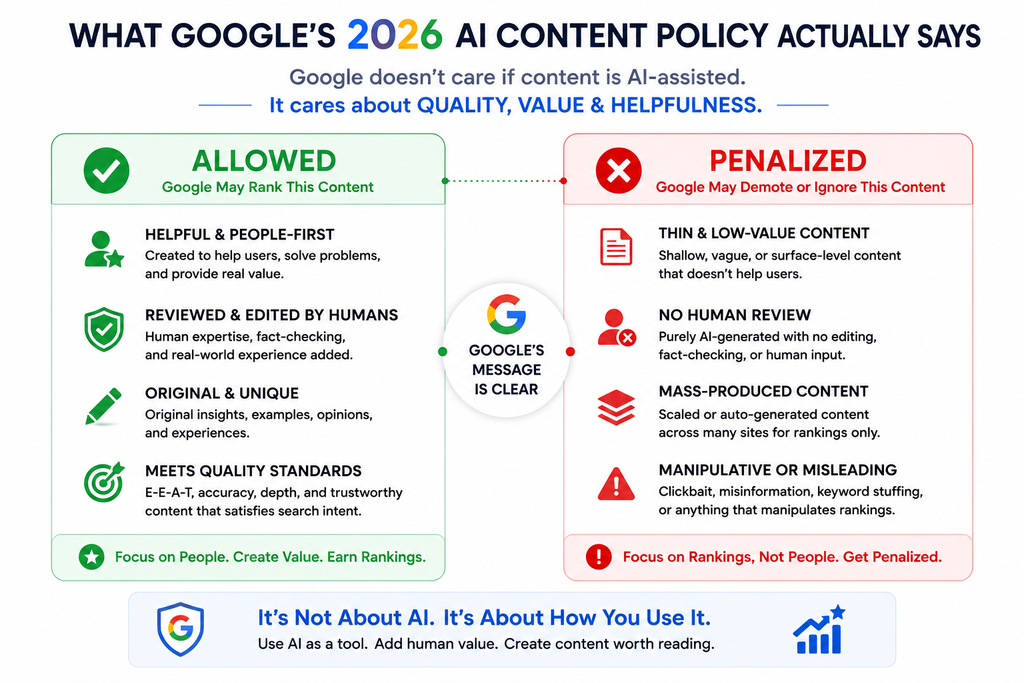
Google’s public position has stayed consistent since it was first published in 2023 and has been reaffirmed through subsequent core updates: content is evaluated on its quality and usefulness, not on whether AI was involved in producing it. There’s no separate “AI penalty.” What Google’s policies do explicitly target is what the company calls scaled content abuse — publishing large volumes of thin, unoriginal, template-driven pages primarily to manipulate rankings, a pattern that predates AI tools and applies whether the content was written by a person or a model.
The practical takeaway for using the prompts above is straightforward: they’re built to accelerate research, structure, and drafting, not to replace the editorial step where a knowledgeable person checks facts, verifies any statistic, and adds a genuine point of view before publishing. Several of the prompts in this library — particularly in the E-E-A-T section — are deliberately written to flag gaps for you to fill rather than to invent supporting detail on their own, since a plausible-sounding but unverified claim is exactly the kind of thing that undermines the trustworthiness Google’s guidelines are checking for.
What the Evidence Suggests
Across current guidance on both AI prompting and Google’s content policies, the same principle shows up twice from different directions. A vague, generic prompt produces vague, generic content, and vague, generic content is precisely what Google’s quality systems are built to identify and demote — regardless of the tool that produced it. Specificity is the fix in both cases: a precisely scoped prompt produces a more useful first draft, and a human editorial pass that adds real expertise, verifies facts, and cuts anything generic is what turns that draft into something that actually holds up under Google’s current standards.
FAQ Section
Does Google penalize content written with AI prompts like these?
No — Google’s stated policy focuses on content quality and helpfulness rather than production method. What it does penalize is thin, unoriginal content published at scale to manipulate rankings, regardless of whether AI or a person produced it.
How many prompts should I actually use for one article?
Not all 50+ at once. A typical article might use one or two from research, one brief prompt, a handful for drafting specific sections, and two or three for optimization and fact-checking before publishing.
Can AI accurately estimate keyword search volume?
Not reliably — search volume and competition data should come from a dedicated tool like Google Keyword Planner, Ahrefs, or SEMrush. AI is better used to group and interpret that data once you have it, not to generate the numbers itself.
Should I disclose that an article was written with AI assistance?
Google does not require disclosure, and its guidelines don’t treat AI assistance itself as a factor in ranking. Some publications choose to disclose it anyway as an editorial trust practice, which is a separate decision from SEO compliance.
What’s the biggest mistake people make with SEO prompts?
Publishing the first AI draft without an editorial pass. Even a well-specified prompt produces a starting point, not a finished, fact-checked, genuinely expert article — the review step is what determines whether it holds up under current quality standards.
How often should I refresh older content instead of writing new articles?
It depends on the topic’s rate of change, but checking your highest-traffic articles every six to twelve months for outdated statistics, tools, or claims is a reasonable baseline, with faster-moving topics needing more frequent review.