
Search “ChatGPT prompts” today and the results look almost identical to each other: long, numbered lists of one-line prompts with no explanation of why they work, no example of what the output actually looks like, and no guidance on what to do when the prompt doesn’t quite fit your situation. Prompt Doom exists because that gap — between a prompt that sounds useful and a prompt that actually produces something usable — is where most people using AI tools get stuck.
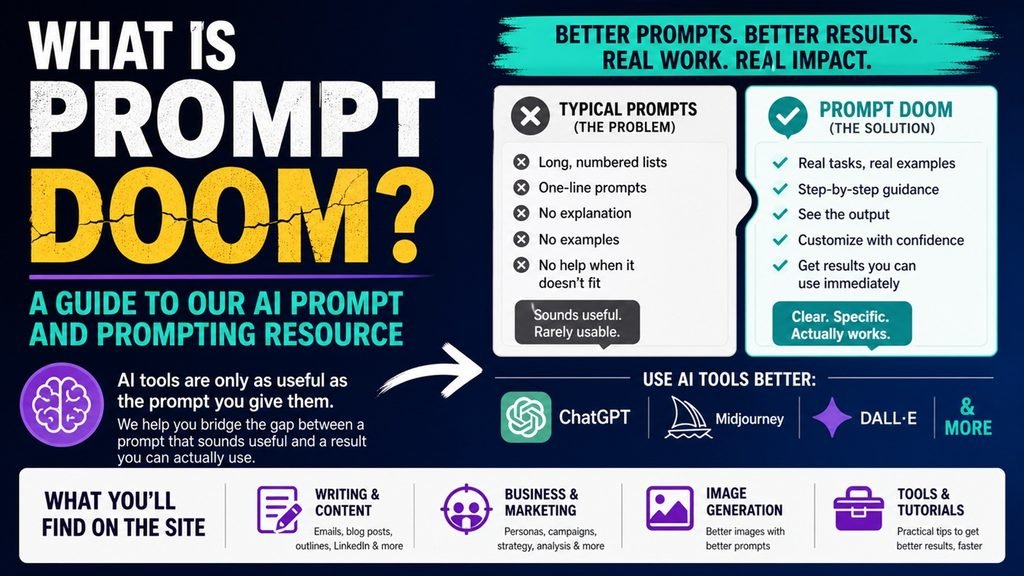
Prompt Doom is a practical resource built around one idea: an AI tool is only as useful as the prompt you give it. ChatGPT, Midjourney, and similar tools can genuinely speed up real work — writing, planning, research, image generation — but only when the person using them knows how to ask in a way the model can actually act on. Most existing content online either oversimplifies that process down to “just ask ChatGPT,” or buries it in prompt-engineering jargon that’s more academic than usable. This site sits deliberately in between: clear, specific, and focused on getting a reader a result they can use immediately, not a theory they have to translate into practice themselves.
What You’ll Actually Find on the Site
Every article on Prompt Doom is organized around a real task, not an abstract AI capability. Rather than a single sprawling page titled “ChatGPT prompts,” the site is broken into focused guides, each built around a specific job someone is trying to get done — writing a cold email that gets a reply, outlining a blog post before the deadline, building a marketing persona that actually shapes a campaign, or figuring out why a LinkedIn post drafted with AI reads as obviously AI-written. The current site structure is split into two main categories, Writing & Content and Business & Marketing, with additional coverage of image generation and other AI use cases as they come up.
A few examples currently live on the site illustrate the approach in practice. One guide walks through fifteen ChatGPT prompts for fixing awkward sentences, each paired with a real before-and-after example so a reader can see exactly what changes and why, rather than just being told the prompt “works.” Another tackles product descriptions, offering a five-part input framework along with a worked example showing the mechanical difference between a generic AI-generated description and one built to actually address a buyer’s hesitation. A third addresses a problem almost every AI-assisted writer eventually runs into — LinkedIn posts that read as AI-generated — by explaining the actual mechanism behind why AI defaults to generic phrasing, not just listing surface-level “tells” like em dashes or stock emojis.
This pattern repeats across the site: a real problem, a specific prompt or framework built to solve it, and a worked example proving the approach holds up rather than asking the reader to take it on faith.
Why Worked Examples Matter More Than Prompt Lists
A prompt without a visible result is a claim, not a demonstration. Plenty of sites publish “50 best ChatGPT prompts” round-ups that read well as content but leave the reader to discover, only after pasting the prompt into ChatGPT themselves, whether it actually produces something useful. Prompt Doom’s approach is built around closing that gap before the reader ever leaves the page — showing the actual input, the actual output, and explaining what changed and why it matters.
This also means the site spends real space on failure modes, not just success stories. Several guides include a dedicated section on the specific ways AI output goes wrong by default — feature-dumping in product descriptions, invented statistics in data-driven content, generic placeholder language in business plans — because knowing what to watch for before publishing is as practically useful as the prompt that generated the draft in the first place.
Beginner-Friendly, Without Being Thin
A recurring goal across the site is making prompt engineering approachable without stripping out the detail that actually makes a prompt effective. Concepts like specifying an audience, providing business or brand context before asking for output, or naming the exact structural problem in a piece of writing rather than asking for a generic fix, get explained in plain language, with the reasoning behind each technique spelled out rather than presented as an unexplained rule to follow.
The result is content that works whether someone is prompting ChatGPT for the first time or already has a working habit they want to sharpen. A first-time user gets a copy-pasteable starting point with an explanation of why it’s structured the way it is; a more experienced user gets the underlying principle they can apply to prompts the site hasn’t written yet.
Who’s Behind It
Prompt Doom is run by Harshit and Sachin, built out of an ongoing habit of testing and refining prompts for everyday work — writing, planning, research, and content — and publishing what actually holds up under real use rather than what sounds good in a listicle. That testing-first approach shapes every guide on the site: prompts get published because they were tried and produced something usable, not because they filled out a round number in a “top prompts” list.
What This Means for Readers
The practical takeaway for anyone visiting Prompt Doom is that the site isn’t trying to be an exhaustive prompt encyclopedia. It’s trying to solve specific, common problems people run into when using AI tools for real work, with enough explanation attached that the underlying skill transfers to situations the site hasn’t covered yet. Whether the task is writing, business planning, marketing, or image generation, the goal on every page is the same: leave with something usable, not just something that sounds like it should be.